Dead Sea

The Dead Sea (Hebrew: ים המלח, Yām HamMẹlakh; "Salt Sea"; Arabic: البَحْر المَيّت, al-Baḥr l-Mayyit; "Dead Sea") is referred in the Bible as both the Salt Sea (Genesis 14:3 (KJV)), the Sea of Alabah (Deuteronomy 3:17 (ASV)) and the Eastern Sea (Joel 2:20 (KJV)).[1] The Dead Sea is also called Lake Asphaltitis.[2][note 1]
Etymology
The name “Dead Sea” comes from there being no life in its waters. This is due to high salinity. However many fungi and other bacteria are living among its presence.
Geography
The dead sea is best known as being the second lowest point on earth at 1,371 feet below sea level and still falling. It is also known as the deepest salt lake in the world, being 1,083 feet deep. The Dead Sea measurements are 42 miles long and 11 miles wide.
History
In the beginning when the Lord was giving the land to Moses he state in Numbers 34:10-13 that in the east coast the land from the Jordan to the Salt Sea was to be his. In geological terms however the Dead Sea is located along the Country of Israel and Jordan.

From the years 1930 to 1977 the sea’s water level has dropped an amazing 21 meters. Because the lake is so big, when it rains the northern half gets an estimate of 5 inches of rain while the southern half only receives 2. Even with the lack of water entering the lake there is still a large amount going out of the lake. There is no outflow.[3] However it has been recorded that an estimate of 840,000 gallons of water a day is evaporated due to the arid climate. This is another reason why the lake is so salty. When the water evaporates it leaves all of its salt and minerals behind. Therefore the lake has both a large amount of salt and minerals which leaves it to be the saltiest and most minerals water in the world.[4] The sea use to get most of its water from the Jordan River that flows out of it, but since the development of a new irrigation system and low rainfall the water supply has grown short.[5] Because of this, around the year 1975 the top layer of the sea started to accumulate more salt then the lower half. Surprisingly however the top layer managed to stay at the top due to its warm temperature and dense waters. Due to the overly excessive amount of salt, the Dead Sea is left with a certain buoyancy that floats whatever enters its waters.
The Dead Sea Scrolls
- Main Article: Dead Sea Scrolls
The manuscripts of the Dead Sea Scrolls were discovered in the years 1946-1947 by three Bedouin of the tribe ta'amireh, Jalil Musa, Yuma Mahoma Jalil and Mahoma Ahmed el Hamed, seeking a lost goat.[6] The location of the find were inside caves at Qumran, near the Dead Sea shores.[6] The Dead Sea Scrolls are famous, largely due to its close connection with literature and history of the Old Testament.[7]
Gallery

Satellite photo
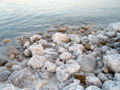
rocks with salt deposits

Caves at Qumran where the Dead sea scrolls were found.
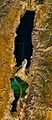
NASA Photo of the Dead Sea


See Also
Notes
- ↑ cf. Josephus' name, Ant. i, 9, 1 in Tenney, Merrill C, ed. (1967). Pictorial Bible Dictionary. Grand Rapids, Michigan: Zondervan Publishing House. p. 204-205. ISBN 0-310-23560-X.
References
- ↑ Wood, D. R. W, ed. (1985). New Bible Atlas. Wheaton, Illinois: Tyndale House Publishers. p. 20. ISBN 0-8423-4675-9.
- ↑ Pfeiffer, Charles F (1979). Baker´s Bible Atlas. Grand Rapids, Michigan: Baker Book House. p. 29. ISBN 0-8010-6930-0.
- ↑ Wright, George Ernest, ed. (1988) (in spanish). Atlas Historico Westminster de la Biblia. El Paso, Texas: Casa Bautista de Publicaciones. p. 20. ISBN 0-311-15030-6.
- ↑ "A Funny Bath" - The Dead Sea Jet Stream Max - National Oceanic and Atmospheric Administration
- ↑ Dead Sea Wikipedia
- ↑ 6.0 6.1 Lamadrid, Antonio González (1971) (in spanish). Los Descubrimientos del Mar Muerto [Dead Sea Discoveries]. Madrid: Biblioteca de Autores Cristianos. p. 26-27.
- ↑ Unger, Merril F (1985) (in portuguese). Arqueologia do Velho Testamento [Archeology and the Old Testament]. São Paulo: Imprensa Batista Regular do Brasil. p. 2.
External Links
- Past Dead Sea levels and biblical historicity by John Woodmorappe Journal of Creation 17(2)90-93. 2003
| |||||||||||||||||||||||


| ||||||||||||||||||||

