Tethys


Tethys or Saturn III is the tenth innermost confirmed moon of Saturn and the fourth (or perhaps fifth) moon of Saturn to be discovered. It is also one of the seven moons of Saturn of dwarf planet size.
Discovery and naming
Giovanni Domenico Cassini discovered Tethys, along with the moons Dione, Rhea, and Iapetus, in the latter half of the seventeenth century, during the reign of "Sun-King" Louis XIV of France.[1] Cassini named these moons the "Sidera Lodoicea" in honor of the king. Later generations (especially after the French Revolution) would not retain such regal flattery.[9]
Sir John Herschel, son of the astronomer William Herschel, suggested the current names of the seven largest satellites of Saturn, including Rhea. Titan received a generic name, and the other six received names of the Titans of mythology. Tethys was the wife of Ocean and the mother of all rivers.[10]
Orbital characteristics
Tethys is in an almost circular orbit around Saturn, at a distance of 294,660 kilometers. Its sidereal month is about 1.89 Earth days. Tethys appears to be in a 2:1 orbital resonance with Mimas.[11]
Co-orbital objects
Tethys shares its orbit with two other moons that occupy its Trojan points, with Telesto in the leading point and Calypso in the trailing point.[11][12]
Tethys actually lies within Saturn's E ring and might therefore be subject to a continuous shower of particles from this ring. This, some authorities suggest, might also be responsible for Tethys' relatively high albedo.[11]
Rotational characteristics
Tethys is in tidal lock with Saturn.
Physical characteristics
Tethys has a density of 960 kg/m³, less than that of water. For that reason, astronomers now believe that Tethys is composed entirely of water ice.[5][8][11] Furthermore, its physical dimensions are most consistent with a homogeneous interior.[13]
Surface
Astronomers currently suggest that the surface of Tethys is geologically old, on account of its many impact craters.[12] But the surface might have been re-formed in the past.[11] The craters of Tethys also have bright, reflective floors.[11]
One of the two most prominent features of the surface of Tethys is the great chasm called Ithaca Chasma. This extends for three-fourths of the circumference of Tethys and measures 65 km wide and several kilometers deep. Most observers suggest that Tethys was once fluid and later froze, with the crust freezing before the interior.[5]
The other feature is the Odysseus basin, a 400-kilometer-wide impact crater that dominates Tethys' western hemisphere. Today the floor of this basin conforms to the spherical shape of Tethys. This basin has no central mountain, and its walls are relatively low.[5][12][11]
Problems for uniformitarian theories posed by Tethys
Tethys is in a circular orbit and therefore could not be subject to tidal heating. Yet if it had been a solid object at the time of the impact that made the Odysseus basin, it would have shattered. To explain this paradox, Chen and Nimmo suggest that Tethys once had a differentiated interior of "a silicate core, a liquid water ocean, a viscous icy mantle and a rigid icy crust."[14] This would require an eccentricity in the distant past as high as 0.02. Chen and Nimmo also believe that Tethys was once in a 3:2 orbital resonance with Dione, but they tend to doubt that this would have had a significant effect.
The obvious problem with this theory is how Tethys could have changed its orbit to one that was nearly circular.
Another problem is what sort of impact could have left the Odysseus basin without itself sending Tethys into a more eccentric orbit, and what became of the impactor. Arnett[8] suggests that the two Trojan moons that share Tethys's orbit might be remnants of that or another collision.
Observation and Exploration
Visiting mission::Voyager 1 and Visiting mission::Voyager 2 both photographed Tethys from a distance, though Voyager 2 made a much closer rendezvous.[15] However, the orbiter of the Visiting mission::Cassini-Huygens mission made an even closer rendezvous (at a distance of 1500 km) on September 23, 2005. No further rendezvous are planned at present.
Gallery
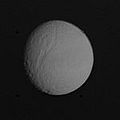
Tethys, taken by Voyager 1; first view of Ithaca Chasma
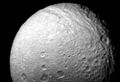
Tethys, taken by Voyager 2; another view of Ithaca Chasma


References
- ↑ 1.0 1.1 1.2 "Gazetteer of Planetary Nomenclature: Planetary Body Names and Discoverers." US Geological Survey, Jennifer Blue, ed. March 31, 2008. Accessed April 17, 2008.
- ↑ 2.0 2.1 2.2 2.3 2.4 2.5 Calculated
- ↑ 3.0 3.1 3.2 3.3 3.4 3.5 3.6 3.7 3.8 Williams, David R. "Saturnian Satellite Fact Sheet." National Space Science Data Center, NASA, November 23, 2007. Accessed June 4, 2008.
- ↑ "Classic Satellites of the Solar System." Observatorio ARVAL, April 15, 2007. Accessed June 12, 2008.
- ↑ 5.0 5.1 5.2 5.3 5.4 5.5 Hamilton, Calvin J. "Entry for Tethys." Views of the Solar System, 2001. Accessed June 13, 2008.
- ↑ Jacobson, R.A., Spitale, J., Porco, C.C., and Owen, W.M., Jr. "The GM Values of Mimas and Tethys and the Libration of Methone." Astron. J. 132:711-713, 2006. doi:10.1086/505209 Accessed June 13, 2008.
- ↑ "Planetary Satellite Physical Parameters." Solar System Dynamics, JPL, NASA. Accessed June 13, 2008.
- ↑ 8.0 8.1 8.2 Arnett, Bill. "Entry for Tethys." The
Nine8 Planets, October 2, 2005. Accessed June 13, 2008. - ↑ Boulay, J. C. "Saturne: les satellites." Astronomie-astronautique. Accessed June 5, 2008.
- ↑ Lassell, William. "Satellites of Saturn." Monthly Notices of the Royal Astronomical Society, 8(3):42-43, January 14, 1848. Accessed June 4, 2008.
- ↑ 11.0 11.1 11.2 11.3 11.4 11.5 11.6 Hubbard, William B. "Tethys." Encyclopædia Britannica. 2008. Encyclopædia Britannica Online. 13 June 2008.
- ↑ 12.0 12.1 12.2 "Entry for Tethys." The Planetary Society, n.d. Accessed June 13, 2008.
- ↑ Thomas, P.C., Veverka, J., Helfenstein, P., et al. "Shapes of the Saturnian Icy Satellites." 37th Annual Lunar and Planetary Science Conference, 2006. Accessed June 13, 2008.
- ↑ Chen, E. M. A., Nimmo, F. "Thermal and Orbital Evolution of Tethys as Constrained by Surface Observations." Thirty-ninth Lunar and Planetary Science Conference, 2008. Accessed June 13, 2008.
- ↑ "Voyager Mission Description." February 19, 1997. Accessed June 13, 2008.
 Browse |
Related Links
| |||||||||||||||||||||||||||||


| ||||||||||||||||||||||||||||||||||||||

