Deimos

Deimos (from the Greek δειμος or deimos panic) is the outer, and the smaller, of the two moons of Mars.
Discovery
Deimos was discovered by the astronomer Asaph Hall on August 12, 1877, at the United States Naval Observatory in Washington, DC.[6][7][8] The astronomer V. Knorre named the satellite Deimos (and also provided the name Phobos for the other satellite that Hall discovered six days later), per a suggestion by Henry G. Madan of Eton, based on the names given in The Iliad for the two servants of Ares, the Greek god of war, named Fear (Phobos) and Panic (Deimos).[9]
Orbital and physical characteristics
Deimos orbits Mars at a distance slightly further away than the distance of a synchronous orbit. For that reason, Deimos rises in the east and sets in the west of the Martian sky, about 2.7 days after its rising.[10]
Deimos is not round, but is shaped like a potato, with dimensions 15 x 12.2 x 11 km. Its largest surface feature is a 2.3 km diameter crater.[10] Deimos is heavily cratered but has a smooth-appearing surface. Its surface gravity is very weak, perhaps too weak to retain the ejecta from a crater impact. This ejecta is likely retained around Mars in a ring and redeposited as regolith on the surface of Deimos as it passes.[11]
Deimos' orbit is so little inclined with respect to the ecliptic that it makes daily transits across the Sun.[10]
Origin
The favored theory among conventional astronomers is that Deimos and its companion moon Phobos are captured C-type asteroids.[3][10] However, that theory is not universally accepted.[3]
Exploration
The NASA Viking 1 and Visiting mission::Viking 2 orbiters both have taken close-up photographs of Deimos on the way to deliver their respective landing craft to the Martian surface. Since then, several missions have made flybys of Deimos, including the Visiting mission::Mars Reconnaissance Orbiter. The two Visiting mission::Mars Excursion Rovers have taken photographs of Deimos as seen from the surface of Mars.
Gallery
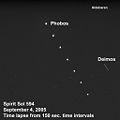
Successive views of Phobos and Deimos photographed from "Husband Hill" by a Mars Excursion Rover
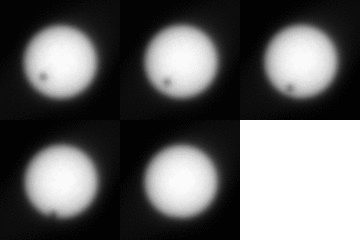
Animated image of Deimos making one of its daily transits of the Sun


 Browse |
References
- ↑ 1.0 1.1 1.2 1.3 1.4 1.5 Calculated
- ↑ 2.0 2.1 2.2 2.3 "Planetary Satellite Mean Orbital Parameters," Solar System Dynamics, JPL, NASA. Accessed February 11, 2008.
- ↑ 3.0 3.1 3.2 3.3 "Fact Sheet for Deimos." Solar System Exploration, NASA. Accessed February 12, 2008.
- ↑ 4.0 4.1 Hamilton, Calvin J. "Mars' Moon Deimos." SolarViews, 2001. Accessed February 12, 2008.
- ↑ 5.0 5.1 5.2 "Planetary Satellite Physical Parameters." Solar System Dynamics, JPL, NASA. Accessed February 11, 2008.
- ↑ Authors unknown. "Notes: The Satellites of Mars." The Observatory, 1:181-185, 1877. Accessed February 11, 2008, from the SAO/NASA Astrophysics Data System, Harvard University.
- ↑ Hall, A. "Observations of the Satellites of Mars." Astronomische Nachrichten, 91(2161):11-14, 1877. Accessed February 11, 2008.
- ↑ Morley, TA. A catalogue of ground-based astrometric observations of the Martian satellites, 1877-1982, Astronomy and Astrophysics Supplement Series (ISSN 0365-0138), 77(2):209-226, February 1989. Accessed February 11, 2008.
- ↑ Knorre, V. "Entdeckung zweier Planeten." Astronomische Nachrichten, 92(2187):47-48, March 14, 1878. Accessed February 11, 2008.
- ↑ 10.0 10.1 10.2 10.3 "Entry for Deimos." The Planetary Society. Accessed February 12, 2008.
- ↑ "Mars: Extreme Planet: Deimos." Mars Exploration Program, NASA. Accessed February 12, 2008.
Related link
| |||||||||||||||||||||||||||||


| ||||||||||||||

