Vertebral column

The human vertebral column is a vital and complex component of the skeletal system that provides movement of the back and neck, and protection for the spinal cord. It is composed of multiple individual bones called vertebrae that are stacked one on top of the other forming a column, which is anatomically divided into five categories.
One of its major purposes is to protect the spinal cord (or spine) and the nerves that run through it, which are vital to the body's central nervous system. These nerves travel through a canal made by the vertebral foramen within the vertebrae. Due to its complexity and frequent use, this important piece of equipment is subject to complications related to several disorders and injuries. Many of the problems that occur are due to nerve compression by bones or muscles within the spine.
Function
The skeleton is the body’s main support system and source of movement. The skeleton is divided into two major sections the axial and appendicular skeleton. The appendicular skeleton is the portion that attaches to the axial part of the body and has limbs attached to it. The axial skeleton is the portion that houses the vertebral column. Its function is to support and protect the head, neck, and trunk. The vertebral column has many important functions within the body. It is a source of protection for the spinal cord, a vital part of the body’s nervous system. It also plays a role in movement, specifically the body’s flexibility.(Wile, p80&87)
Each of the bones has specific functions. Like other bones in the body, the vertebrae produce red blood cells, are a source of mineral storage, protect organs and the spinal cord, attach ligaments, tendons, and muscles, act as a structural support, and provide flexibility and motion. [1] While the outer part of the vertebra is made up of cortical bone the inside consists of cancellous, or spongy, bone. The dense cortical bone is strong and solid and can protect the bone. The cancellous bone is made up of loosely knit structures. Inside the bone is bone marrow that forms red and white blood cells.[2]

Ligaments in the spine attach the bones to each other and provide the vertebral column with a brace to protect from injuries. Such injuries include hyperextension and hyperflexion. As the body rests and as it moves it gives joints its stability.[3]
The tendons are accountable for attaching muscles to the vertebra bones. These retain a certain elasticity to them because of the fibrous bands that make them up. They are a band of densely packed collagen fibers.[4]
Muscles in the spine make up a very complex system made up of several different muscle types. These muscles play a vital role in the movement of the upper body by flexing, rotating, and extending. It also provides the vertebral column with a great amount of support and stability.[5]
Column
The vertebral column consists of four main regions. The cervical vertebrae are primarily for the neck as it moves and supports the head. It can be divided into two parts, the upper and lower parts. The upper part consists of two vertebrae called the atlas and axis. The atlas is formed specifically to support the head. It has a ring shape and looks different than other vertebrae. The posterior and anterior arches combine two lateral masses that form the atlas bone. The axis provides the head with movement by allowing it to pivot. It has a dens, or odontoid, process that projects upward and connects with the atlas. [6]
The thoracic vertebrae supports the chest cavity of the body. They join with the rib cage as it wraps around the cavity. The only ribs that are not attached are the eleventh and twelfth, which are called floating ribs. The size of each bone increases from top to bottom. Unlike the cervical vertebrae, they are more limited as far as movement is concerned. Each vertebra in this portion has a large intervertebral foramen for nerves, a long spinous process, and small pedicles.[7]
The lumbar vertebrae supports the lower back. Just like the thoracic vertebrae, they too increase in size from top to bottom. Being at the bottom of the vertebral column, they support much of the weight. They also obtain a lot of biomechanical stress. They have long and wide pedicles and the spinous processes are different from the others in that they are horizontal and square shaped. Despite the fact that the intervertebral foramen are also large, nerve compression is common within the lumbar vertebrae.[8]
The sacrum is located within the pelvic girdle and is made up of five separate bones that fuse together as a person matures. At the very end of the vertebral column is the coccyx, which is also a part of the pelvic girdle. It is made up of three bones and is commonly known as the tailbone.[9]
Vertebra

The vertebral column is a combination of several bones stacked on top of each other in a vertical fashion. It is divided into five separate sections as noted above, each consisting of a different type of vertebra bone, called the cervical vertebrae, thoracic vertebrae, lumbar vertebrae, a sacrum, and a coccyx. The very first set is the cervical vertebrae which has seven bones. Being at the top of the spine, its main function is to support the head and the neck. Next, the thoracic vertebrae contain twelve vertebrae. It houses the body’s major organs and connects with the ribs within the thoracic cage. The lumbar vertebrae has five vertebrae too. Its purpose is to support the upper body regions such as the torso and the lower back. The lumbar and cervical vertebrae allow spinal nerves to enter and exit the spine. (Wile, p87-90)
There are many intricate parts that make up each vertebra and its support system. The intervertebral disks serve two main functions within the vertebral column. First, it is located between each vertebra and helps to support it while keeping each of them connected. Because of its unique location, it helps to keep the bones from rubbing against the other. The body of the vertebra is used to support the weight of the vertebral column. It is a major portion of the vertebra and takes up a significant section. The vertebral foramen is the continuous hole through which the spinal cord will travel through from when it enters to when it exits. This foramen is surrounded by a vertebral arch. (Wile, p87-90)
There are also several processes that also pertain to each vertebra which give it the ability to move. The transverse process is found on either side of the vertebra. The spinous process, on the other hand, is found on the posterior side and slants downward. This is what a person can see and feel in the middle of their back. The muscles that correspond with this process impacts most of the spine's movement. The superior articular process and the inferior articular process work together for a common function. The superior articular process is found in the posterior region pointing up, while the inferior articular process is found, although posteriorly, on the underside at the base of the spinous process. Their names are thus because of their locations the superior, above, process and the inferior, below, process. Together they overlap one another when the vertebrae are stacked. This allows the spine to move fluidly as they correspond with each other and also adding firmness. (Wile, p87-90)
The annulus fibrosus is a sturdy structure that surrounds the nucleus pulposus, a gel-like center. The annulus fibrosus aids in spinal rotation, structural stability, and compressive stress. It is a combination of water and elastic collagen fibers. Its center, the nucleus pulposus, allows stress and weight to be distributed throughout the vertebra. It is made up of water, collagen, and proteoglycans. [10]
The human vertebral column is a combination of both convex, kyphotic, and concave, lordotic, curves. [11] This arrangement of arcs provide the body with a spring that will help in impact absorption as the body moves. Depending on the view the cervical and lumbar vertebrae have a convex, or concave, curve, while the thoracic vertebrae and sacrum have a concave, or convex curve. These curves are not always present within the human body; they must take time to fully develop. At birth the vertebral column is made up of a single concave curve. When the baby reaches two month of age it will develop the convex curve of the cervical vertebrae because the baby will need support as it lifts its head. At six months, as the baby learns to sit up, the convex curve of the lumbar vertebrae develops. (Wile, p87-88)
Skull
The vertebral column is the support system for the skull. The first cervical vertebra is connected to the base of the skull. Between the skull and the vertebra there are many neurological and vascular structures including an enormous amount of nerves, blood vessels, and ligaments crossing throughout that junction. A hole in the base of the skull, the foramen magnum, is where the spinal cord exits the cranium and aligns with the intervertebral foramen to enter into the spine. On either side of the foramen magnum there are two occipital condyles. These kidney shaped organs are attached to the articular facets of the atlas of the cervical vertebrae. Its main function is for balance. The ligament and muscles serve to not only hold the head to the body, but to keep the head perpendicular to the spine. A big concern comes when the skull displaces from the vertebra as a result of a strike on the head. When this happens the nerves and blood vessels are at risk of becoming compressed by the muscles and ligaments which spasm in reaction to the hit. As a consequence there may become muscle problems, biomechanical changes in the spine, postural changes, and dysfunction in organs. [12]
Spinal Cord

The spinal cord is a cylindrical structure that is held within the vertebral column. In combination with the brain, together they make up the central nervous system. It carries nerve impulses between the brain and the spinal nerves. [13] The spinal cord is responsible for several different functions within the body. These include transmissions of nerve impulses, sensory signals from peripheral regions to the brain, motor signals from the brain back to the peripheral regions and spinal reflexes, sensory information, and the response through motor impulses that control muscles. The spinal cord is basically an extension of the brain stem. From the brainstem it travels from the foramen magnum in the skull down to the first lumbar vertebra. When it tapers off, the tip of the cord is then called the conus medullaris. As it runs through the vertebral column it is held in place by the denticulate ligaments. These ligaments are extensions of the pia mater, which are attached to the dural sheath, that run laterally. At the end it is then stabilized by the filum terminale, which is attached to the coccyx in the pelvic girdle by extension of the pia mater. The spinal cord is where several branches of spinal nerves join together by roots. The ventral roots and dorsal roots are the two main roots in the spinal cord. On the ventral side of the spinal cord, the ventral roots contain motor nerve axons and send nerve impulses from the spinal cord to the different skeletal muscles. On the dorsal side of the spinal cord, the dorsal root holds sensory nerve fibers. It is also responsible for transmitting nerve impulses from the peripheral regions to the spinal cord. [14]
There are several different nerves that course throughout the vertebral column. They make up a total of thirty-one pairs of spinal nerves. [15] These include eight pairs of cervical nerves that run through the head and neck to the shoulders, arms, and hands. Twelve pairs of thoracic nerves which attach the upper areas of the abdomen and the muscles in the chest and back. Five pairs of lumbar nerves are responsible for producing nerves to the lower section of the back and to the legs. The five pairs of sacral nerves assist the lower sectors of the body such as the buttocks, anal and genital regions, legs, and feet. The dermatomes’ job is to supply the surface of the skin with nerve fibers from a single spinal root. [16] Spinal nerves exit the spinal cord by two means; these being the ventral root and the dorsal root. The first pair emerges from in between the occipital bone of the skull and the atlas of the spinal column. The remaining nerves come through the intervertebral foramen that rests in the center of each vertebra. The ventral and dorsal roots rest on both sides of the spinal cord. As the nerves exit the spinal column they divide up into several different branches: the dorsal ramus, ventral ramus, meningeal brach, and rami communicantes. The functions for each are specialized for specific portions of the body. For example, the dorsal ramus is responsible for the dorsal section of the trunk of the body, while the ventral ramus is responsible for the ventral half of the body plus the upper and lower limbs. The ventral rami will conjoin together to form a network of interconnecting nerves that is called plexus. The plexus has fibers that are obtained from the spinal nerves and travel to one specific destination.The meningeal branch will go back into the vertebral column where is will assist the meninges, which are membranes that enclose the central nervous system that consist of the dura mater, the arachnoid mater and the pia mater, and the blood vessels within the vertebra. The rami communicantes will take care of the visceral functions such as heart rate, blood pressure, and respiration. [17]
Injury
There are multiple different injuries that the spinal column is susceptible to during a person’s lifetime. The most common of these are caused by three main reasons that cause severe pressure to be applied to the spine: longitudinal compression, hinging, and shearing. Longitudinal compression results when a person falls when landing hard on their feet. This action puts immediate pressure on the bones in the spine by crushing the vertebra lengthwise against one another. Hinging results in cases such as whiplash when a person is in a situation where there is acceleration and then a sudden and violent recoil in motion. Shearing is the consequence of a fall when the body is pushed over with a great amount of force. The effects of shearing are actually caused by a combination of both hinging and excessive twisting of the spine. These three forms of abnormal pressure on the spine may cause dislocation to the vertebrae, fractures, and ruptured ligaments. Minor cases will only result in pain and swelling. In more severe cases the spinal cord may become a factor with nerve functions being affected and possibly cut off. [18]
Herniated disc

A herniated disc is caused by a crack in the annulus fibrosus, the outer layer. The vertebral disc is made up of strong connective tissues. Its function is to support the vertebral column by holding it together and to act as a cushion between each vertebra. When a person grows older the disk begins to lose its water content which is the main component that acts as padding between the bones in the spine. When this happens it opens the window for problems such as displacement of the disc center. This displacement becomes a herniated, or ruptured, disc. Most of the trunk of the body’s weight puts pressure on the lower vertebrae, the lumbar vertebrae. Because of all the weight, herniated discs are common in the lower lumbar vertebrae, such as the two lumbar discs that are located at and below the waist. These complications lead to even more problems involving the nerves. When nerves are compressed by the bones in the spine it can cause numbness, tingling, pain, weakness in the legs, and back pains. These symptoms are the consequence of sciatica. Sciatica is an additional condition that occurs in 1-2% of people between the ages of 30-50. [19]
For people with herniated discs there are multiple treatment options available. Those with minor problems are 80-90% likely to have no need for any surgical operations. When these occurrences become apparent the first few weeks will generally be on an observational basis. Some other non-surgical options available are resting, anti-inflammatory medications, analgesic drugs for the pain, physical therapy, exercise, or epidural steroid injection therapy. The goals for these treatments are to relieve some of the irritation caused to the nerves and to improve the overall physical condition of the disc. By strengthening the disc it will help protect and stabilize the vertebral column and increase its overall usage. If surgery does become necessary, the success rate is in the 90+ percentile in relieving leg pains. The surgery is only responsible for decreasing the pain and weakening of the muscles, but it will not return any lost leg strength. Although it may help relieve some of the back pains, their overall success rate is not as high. The main purpose of the surgery is to cut down nerve irritation by fixing any compression (discectomy or partial discectomy) and removing part of the herniated disc. By taking a surgical standpoint there are always complications that may arise. In this particular case, bleeding, tearing, and infection are common after effects of surgery. In addition, 5% of all patients will experience another rupture of the disc following the first. [20]
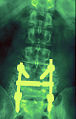
Spinal cord injury surgery
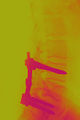
Spinal cord injury surgery


Disorders
Scoliosis
- Main Article: Scoliosis
Scoliosis is a disorder in the spine where there is an abnormal curve to the vertebral column. While normal vertebral columns have a convex and a concave curve, a person with scoliosis will have additional curves to either of its sides. This accumulation of curves will create a corkscrew effect because of the twisting nature of the bones. This abnormality is often times hereditary, being passed down from generation to generation. It is most often found in females rather than males. The average age when obtaining this oddity is commonly after the age of 10, but it is not restricted to any specific age range. [21]
Different forms of scoliosis can be divided into four categories (three specific): functional, degenerative, neuromuscular, and then others. Functional scoliosis is the result of dysfunctions in other parts of the body that disrupt the spine. Degenerative scoliosis is when arthritis takes control of the spine and causes tissues and muscles to weaken in the vertebral column, allowing the spine to curve unnaturally. Neuromuscular scoliosis is the worst of all because it is the result of a lack of full bone formation or when the vertebrae fail to separate. The other types of scoliosis are generally caused by a benign tumor(s) on the spine. The type of disorder is deciphered upon the individual based on the causes and the age of the person when the curvature began to develop. [22]
While professionals have yet to find the cure for this disorder, doctors have designed several treatment options for those seeking medical attention. There are three main treatment options available for patients: observation, bracing, or surgery. The different types of scoliosis will generally have different treatment plans depending on the severity of each case. Treatment for functional types will not affect the spine directly; the only way to fix the spine will be to treat the specific body part that is disturbing the spine. For degenerative cases there are several options such as physical therapy, various exercises, chiropractic, or surgery. If surgery is requested the goal of it would be to decompress or remove the bone spurs that are compressing the nerves or fusion which will help to correct the curve by stabilizing the spine. Because neuromuscular scoliosis is generally more severe, surgery is most often inevitable for its patients. For other types, specifically those who have tumors, surgery will remove the tumor and correct the spine. [23]

References
- Wile, Jay L., Shannon, M., The Human Body: Fearfully and Wonderfully Made! Apologia Educational Ministries, Inc. pg. 80, 87-90.
- Vertebral Column Spine Universe. by Keith Bridwell, MD
- Spinal Nerves Articles.DirectoryM.net
- The Spinal Cord Articles.DirectoryM.net
- Understanding Spinal Anatomy: Overview of the Spine Colorado Comprehensive Spine Institute
- Scoliosis MedicineNet.com. Jason C. Eck, DO, MS
- vertebral column Enotes
- Herniated Lumbar Disc North American Spine Society (NASS)
- Skull Base (Craniocervical) Anatomy upCSpine.com
External Links
| ||||||||||||||||||||


