Human brain

The Brain is the part of the central nervous system that includes all the higher nervous centers which are enclosed within the skull. It is responsible for one's thoughts and feelings and is considered the seat of the faculty of reason. The human brain is indeed an example of the complexity and uniqueness that caused the psalmist to describe our workings as both fearfully and wonderfully made.[1].
The brain is the most complex part of the human body. This three-pound organ is the seat of intelligence, interpreter of the senses, initiator of body movement, and controller of behavior. Lying in its bony shell and washed by protective fluid, the brain is the source of all the qualities that define our humanity. The brain is the crown jewel of the human body.[2]
For centuries, scientists and philosophers have been fascinated by the brain, but until recently they viewed the brain as nearly incomprehensible. Now, however, the brain is beginning to relinquish its secrets. Scientists have learned more about the brain in the last 10 years than in all previous centuries because of the accelerating pace of research in neurological and behavioral science and the development of new research techniques. As a result, the U.S. Congress named the 1990s the Decade of the Brain.[2]
Structures
Divisions
The brain has seven divisions in all, each with a specific job. The mesencephalon is what connects the hindbrain to the brain stem. This is sometimes referred to as the midbrain. The mesencephalon’s functions include sight, pupil dilation, eye movement, body movement, and hearing. [3]
Prosencephalon is also known of as the forebrain, its functions include chewing, smell, taste, salivation, and swallowing-to name a few. Two smaller divisions of the prosencephalon are the diencephalon and telencephalon. The diencephalon controls vision, facial sensation, phonotation, and vision. The Telencephalon is the division with the important job of determining intelligence, personality, sensory impulses, motor functions, planning, organization, smell, and touch. [4]
The rhombencephalon, or hindbrain, is located in the latter part of the brains stem. It is also divided into two smaller divisions. The first is called the metencephalon, which is in control of balance, muscle tone, arousal, circulation, and sleep. It is located above the medulla oblongata and it consists of the brain's cerebellum and pons. Pons act as neuron pathways that conduct messages from the cerebellum and spinal cord. Pons also help monitor the body's respiratory actions. [5]
Lobes

- Main Article: Lobes of the brain
Each cerebral hemisphere can be divided into sections, or lobes, each of which specializes in different functions. To understand each lobe and its specialty we will take a tour of the cerebral hemispheres, starting with the two frontal lobes, which lie directly behind the forehead. When you plan a schedule, imagine the future, or use reasoned arguments, these two lobes do much of the work. One of the ways the frontal lobes seem to do these things is by acting as short-term storage sites, allowing one idea to be kept in mind while other ideas are considered. In the rearmost portion of each frontal lobe is a motor area, which helps control voluntary movement. A nearby place on the left frontal lobe called Broca’s area allows thoughts to be transformed into words.[2]
When you enjoy a good meal—the taste, aroma, and texture of the food—two sections behind the frontal lobes called the parietal lobes are at work. The forward parts of these lobes, just behind the motor areas, are the primary sensory areas. These areas receive information about temperature, taste, touch, and movement from the rest of the body. Reading and arithmetic are also functions in the repertoire of each parietal lobe.[2]
As you look at the words and pictures on this page, two areas at the back of the brain are at work. These lobes, called the occipital lobes, process images from the eyes and link that information with images stored in memory. Damage to the occipital lobes can cause blindness.[2]
The last lobes on our tour of the cerebral hemispheres are the temporal lobes, which lie in front of the visual areas and nest under the parietal and frontal lobes. Whether you appreciate symphonies or rock music, your brain responds through the activity of these lobes. At the top of each temporal lobe is an area responsible for receiving information from the ears. The underside of each temporal lobe plays a crucial role in forming and retrieving memories, including those associated with music. Other parts of this lobe seem to integrate memories and sensations of taste, sound, sight, and touch.[2]
All together, these incredible regions of the body's most sophisticated organ work in harmony to distinguish humans as unique beings created in the image of God.
Cerebral Cortex
Coating the surface of the cerebrum and the cerebellum is a vital layer of tissue the thickness of a stack of two or three dimes. It is called the cortex, from the Latin word for bark. Most of the actual information processing in the brain takes place in the cerebral cortex. When people talk about "gray matter" in the brain they are talking about this thin rind. The cortex is gray because nerves in this area lack the insulation that makes most other parts of the brain appear to be white. The folds in the brain add to its surface area and therefore increase the amount of gray matter and the quantity of information that can be processed.[2]
Inner Brain
Deep within the brain, hidden from view, lie structures that are the gatekeepers between the spinal cord and the cerebral hemispheres. These structures not only determine our emotional state, they also modify our perceptions and responses depending on that state, and allow us to initiate movements that you make without thinking about them. Like the lobes in the cerebral hemispheres, the structures described below come in pairs: each is duplicated in the opposite half of the brain.[2]
The hypothalamus, about the size of a pearl, directs a multitude of important functions. It wakes you up in the morning, and gets the adrenalin flowing during a test or job interview. The hypothalamus is also an important emotional center, controlling the molecules that make you feel exhilarated, angry, or unhappy. Near the hypothalamus lies the thalamus, a major clearinghouse for information going to and from the spinal cord and the cerebrum.[2]
An arching tract of nerve cells leads from the hypothalamus and the thalamus to the hippocampus. This tiny nub acts as a memory indexer—sending memories out to the appropriate part of the cerebral hemisphere for long-term storage and retrieving them when necessary. The basal ganglia (not shown) are clusters of nerve cells surrounding the thalamus. They are responsible for initiating and integrating movements. Parkinson’s disease, which results in tremors, rigidity, and a stiff, shuffling walk, is a disease of nerve cells that lead into the basal ganglia.[2]
Ventricles
The brain contains four ventricles, one median cavity, two of them lateral and the other normal, minor when compared to the other three. Each of the ventricles is filled with a cerebrospinal fluid which makes up the choroid plexuses. The choroid plexuses are made up of tiny blood cells grouped together, these are what make up the sides and tops of the ventricles[1]. The median cavity ventricle (third ventricle) is held down by the hypothalamus[2] and the thalamus [3].
The two lateral ventricles (first and second ventricles), positioned in the cerebral hemispheres in the middle of the brain, form a triangular shape with four “horn-like” figures. This ventricle sends signals to the third ventricle via the inter ventricular foramen. The lowest in importance of the ventricles (the fourth ventricle) stretches from the middle of the brain to the central canal located at the top of the spinal cord. It serves a bridge-like purpose transmitting information and releasing the cerebrospinal fluids into the subarachnoidal area, courtesy of the two Luschka[4] orifices’, along with the orifice of Magendie[5].
Blood Brain Barrier
Everyone's brain has a special system that keeps out most molecules and which only allows certain substances to enter the brain. The brain needs oxygen and glucose and other nutrients, but must be very carefully protected from the entry of bacteria, and even from the entry of most molecules, especially ions. This barrier is very important to our continued survival and ability to think. It hampers doctors, who would like to be able to have certain medications enter the brain.[6]
Recently, researchers found that cells called pericytes are especially important in maintaining the barrier. Many are found near blood vessels in the brain to help ensure that immune system molecules which cause inflammation and swelling are prevented from entering the brain, though those molecules are necessary for other parts of the body. Previously, many researchers thought that cells called astrocytes were most likely the ones that maintain the blood brain barrier, but the new research shows that the pericytes are more important and are present long before birth. The blood brain barrier is present well before we are born. [7]
Development

When a baby is born, its brain is close to 25% of its entire body weight. As a human baby grows, its brain will generate cells on a scale of hundreds of trillions. A baby's brain undergoes many important developments up to the age of three. When a baby is born, its essential neurons are already in place; they need only to be developed. Neurons are able to "speak" to each other over synapses (what can be described as a telephone wire). Synapses form after birth, and their job is almost never over. Though synapses will continue to form throughout our lifetime, an exhausting number of synapses are formed in our first three years of life. [8]
There is an interesting part of childhood development that takes place in the brain during infancy, it is referred to as "pruning." Pruning is a systematic efficiency tool in the brain that examines synapses and gets rid of the ones that are no longer in use. It is detrimental to a child if they are not stimulated enough, or exposed to enough life experiences. New learning opportunities create synapses, and in the case of an under-stimulated child, when it's time for the brain to start "prunning" it will wipe away what few synapses there are. This leads to what is called "underdevelopment." In any case, after prunning is over, the synapses become permanent. This makes early childhood "underdevelopment" an almost irreversible handicap.[9]
Congenital contracts are defined as mutations of synaptic development, and are formed early in a child's development. These contracts originate in the brain, they mature as the brain does. These contacts cause obstructions with eyesight when they are finally matured. Doctors are finding new ways to prevent blindness by extracting these congenital contracts early on in their development.[9]
The human brain will grow depending upon the terms of its use. The more experiences a young child is exposed to, the more its brain will develop according to those experiences. In an example given by the Zero to Three Foundation: it is not the ability to speak that is unique in brain development, but the ability to learn a specific language. A child's brain can "organize" the words and sounds it hears. The brain can remember certain sounds it hears, and eventually memorize them. The ability to do this quickly and efficiently ceases on average by the age of ten. Listening to sounds seemed to not make a difference when young children who were tested were trying to grasp a language. Instead, speech-induced interaction was the way that most young children successfully learned a language.[9]
Early trauma can lead to complications that last an entire lifetime. The brain remembers trauma, even if the traumatic event itself is forgotten or "blocked out.” After a seriously traumatic event, a child can get what is called Post Traumatic Stress Syndrome. PTSS causes children to have serious learning disabilities, and often times the victims stay in a state of constant alert. This "constant alert" produces high levels of adrenalin and cortisol (stress hormones). This imbalance can persist throughout a lifetime. It can even cause small brain sizes according to the Baylor College of Medicine.[9]
Disease

Brain diseases and mental illnesses come in a variety of forms that have many symptoms, some hardly noticeable and others hard to avoid. Encephalitis is characterized by an "inflammation of the brain" and its symptoms consist of various brain-related discomforts such as: headache, fever, drowsiness, vomiting, confusion, and seizures[10]. Other serious brain diseases are strokes and brain tumors. A stroke occurs when blood flow to the brain ceases, thus causing brain cells to rapidly deteriorate and eventually die. There are two specific kinds of stroke. There are ischemic strokes and there are hemorrhagic strokes. Ischemic strokes occur when a blood vessel cannot allow the passage of blood due to a clot. Hemorrhagic strokes occur when a blood vessel in the vain violently erupts[11]. Brain tumors go by many names, sometimes they are referred to as glioma or meningioma, but their official title is "cancer". Metastatic brain cancer does not originate in the brain, it is created somewhere else in the body and eventually moves into the brain. The symptoms can often be as innocuous as a headache, or as obvious as twitching and jerking. Brain cancer comes it two forms: it can either be benign, which means it is relatively harmless, or it could be malignant, which means it is both dangerous and destructive[12].
- Leukodystrophy attacks the myelin sheath, which encases the brain's nerve cells. The after affects of Leukodystrophie can be slowness in physical development and the senses such as hearing, and vision.[13]
- Phenylketonuria is a genetic disorder in which the brain cannot process a special protein called phenylalanine. Because the brain can't process this protein, it begins to build up in the brain causing retardation. If the disease is found early, a diet of low-protein foods could avoid this outcome. [14]
- Tay-Sachs disease is a genetic disorder that targets the brain's nerves with buildup of fatty tissues. As the nerves are destroyed, so are the person's ability to see, hear, swallow, which eventually leads to paralysis. There is no cure for this disorder, and most babies born with it die by the age of four.[15]
- Wilson disease is both a brain and liver disorder. When the brain fails to send signals to the liver to release copper (which would otherwise be excreted from the liver and into the other parts of the digestive tract) it builds up and destroys the liver. Not only does this disease affect a person's brain and liver, but it also destroys the eyes and kidneys. Unlike Tay-Sachs disease, this genetic disorder is curable with supplements and a low-copper diet. [16]
Mental Illnesses
- Alzheimer's disease
- Anxiety
- Asperger syndrome
- Attention deficit hyperactivity disorder
- Bipolar disorder
- Bovine spongiform encephalopathy
- Bulimia nervosa
- Childhood amnesia
- Dementia
- Depression
- Dissociative identity disorder
- Dyslexia
- Erotomania
- Insomnia
- Obsessive compulsive disorder
- Paranoid personality disorder
- Paranoid schizophrenia
- Personality disorder
- Posttraumatic stress disorder
- Schizophrenia
- Stroke
- Walking corpse syndrome
Creation vs. Evolution

According to Talk.Origins, brain sizes are relative to the size of the person who possesses them. For example: women and men differ in size, therefore their brains do as well. Though brain sizes in humans varies, it appears that intelligence stays the same. The author of the article "Creationist Argument: Brain Sizes" states that a gap was bridged when primates evolved into man. The author claims that missing links had brain sizes between the average sizes for human and ape. A human brain will range between 1000 and 1500 cc, whereas the chimpanzee's will average closer to 400 cc. According to this source, creationists (such as Marvin Lubenow) have claimed that brain capacities as low as 700 exist in humans to discredit "missing links" (i.e ER 1470) as being within the normal range of humans.[17]
According to Acts 4:32a "All the believers were one in heart and mind." In Romans 4:27a Romans 8:27 it says "And he who searches our hearts knows the mind of the Spirit, because the Spirit intercedes for the saints in accordance with God's will." From this we see that God has a mind and we do too, this ties into a verse in Genesis 1:27a Genesis 1:27 that states "So God created man in his own image, in the image of God he created him; male and female he created them." God created us in His image, He not only created us- but He gave us a mind just like his.
Gallery
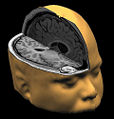
Digitalized Image of a Human Brain's Core
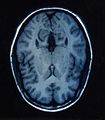
MRI of a Human Brain
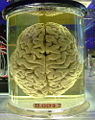
A Human Brain Preserved in Formaldehyde


References
- ↑ Psalm 139:14
- ↑ 2.0 2.1 2.2 2.3 2.4 2.5 2.6 2.7 2.8 2.9 Brain Basics: Know Your Brain by the National Institute of Neurological Disorders and Stroke, Last updated August 18, 2010.
- ↑ Mesencephalon About.com: Biology. Febuary, 6 2009
- ↑ Prosencephalon About.com: Biology. February, 6 2009
- ↑ Rhombencephalon About.com: Biology. February, 6 2009
- ↑ Guards of the blood-brain barrier identified - Pericytes crucial to protecting central nervous system by Rachel Ehrenberg Science News Web edition : Wednesday, October 13th, 2010. Accessed October 14, 2010.
- ↑ Guards of the blood-brain barrier identified - Pericytes crucial to protecting central nervous system by Rachel Ehrenberg Science News Web edition : Wednesday, October 13th, 2010. Accessed October 14, 2010.
- ↑ Brain Development ZERO TO THREE: National Center for Infants, Toddlers and Families. February, 6 2009
- ↑ 9.0 9.1 9.2 9.3 Starting Smart ZERO TO THREE: National Center for Infants, Toddlers and Families. February, 6 2009
- ↑ Encephalitis MedlinePlus. U.S. National Library of Medicine. November, 15 2008
- ↑ Stroke MedlinePlus. U.S. National Library of Medicine. April, 24 2008
- ↑ Brain Cancer MedlinePlus. U.S. National Library of Medicine. January, 21 2009
- ↑ Leukodystrophies MedlinePlus. U.S. National Library of Medicine. November, 17 2008
- ↑ Phenylketonuria MedlinePlus. U.S. National Library of Medicine. November, 20 2008
- ↑ Tay-Sachs Disease MedlinePlus. U.S. National Library of Medicine. April, 24 2008
- ↑ Wilson Disease MedlinePlus. U.S. National Library of Medicine. January, 21 2009
- ↑ Creationist Arguments: Brain Sizes Talk Origins.org. Jim Foley. November, 30 2002
| ||||||||||||||||||||


