Gap theory creationism

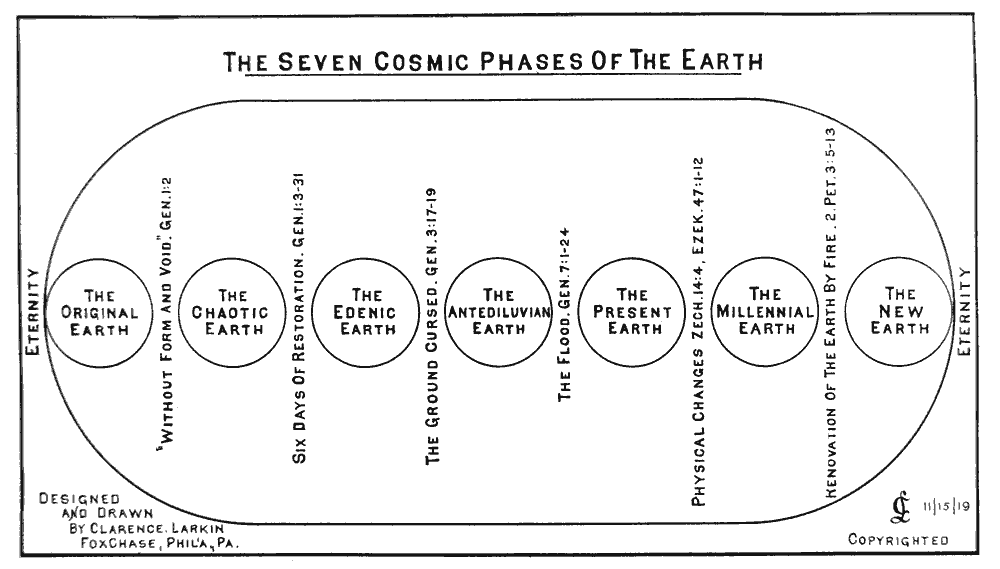
Gap Theory Creationism, also known as the Ruin-Reconstruction interpretation of Genesis, is a belief system which holds that there is a "gap" of time inferred from the Bible during which the Earth became "ruined", and was then "reconstructed" during the six days of creation described in Genesis. The gap theory claims that God pronounced a cataclysmic judgment upon the earth during this period (Gap) as the result of the fall of Lucifer (Satan) and that the verses following Genesis Chapter 1:2 describe a re-creation or reforming of the earth from a chaotic state; this re-creation, then, is not the first creative work of God.
The gap theory allows for both the geologic evidence of an old earth and the literal wording of the Holy Bible. It does not need to appeal to evolution, parable, symbolism, or allegory, nor does it deny accepted scientific data. Therefore, proponents believe it deserves full consideration.
Beliefs
Gap of Time
Gap theorists generally assert that an indefinite span of time exists between Genesis 1:1 and Genesis 1:2. The time span can be, and usually is, very large (Millions or Billions of years) encompassing the so-called “geologic ages.”
"And the earth was without form, and void; and darkness was upon the face of the deep. And the Spirit of God moved upon the face of the waters." - Genesis 1:2
Where Moses left off in presenting the revelation he recorded the 80 days he spent with the LORD, Jeremiah expounded on the judgment that existed before Adam in greater detail.
"I beheld the earth, and, lo, it was without form, and void; and the heavens, and they had no light. I beheld the mountains, and, lo, they trembled, and all the hills moved lightly. I beheld, and, lo, there was no man, and all the birds of the heavens were fled. I beheld, and, lo, the fruitful place was a wilderness, and all the cities thereof were broken down at the presence of the LORD, and by his fierce anger." - Jeremiah 4:23-26
Proponents of the Gap teaching point out that the men that 'could not be found' & the cities that were destroyed were not men from the seed of Adam. In agreement with natural geological studies, the 'men' that rebelled were beings that lived during the Ice Age period. Where science does not have an answer for the spiritual events on planet earth, it inserts it's opinions & hypotheses. However, in their study of the 'men' during the Ice Age, they have found beings with a genetic code unlike ours, yet very human-like.
It is important to study the Hebrew definitions in both Genesis & Jeremiah as to why the earth became this way. These two Scriptures are the only reference where the earth, or the physical ground, is described as 'without form and void'. The Hebrews Strong's definition for 'without form' is 8414, are the following:
| “ |
a) formlessness (of primeval earth): nothingness, empty space |
” |
In God's dealings with sin & rebellion, sinful beings were destroyed by their nature's becoming violently perverted to Lucifer's propaganda against the Godhead. In the widely understood & excepted judgment in Noah's day, there is a detailed event of the race of men that refused to follow God. In the not-so detailed judgment in Lucifer's day, we rely on the harmony of Scriptures to ascertain why the LORD had fierce anger to the point of taking the earth to a place that was made an 'empty formless space'.
In enters the apostle Peter in the New Testament, who expounds even further on the judgment of Lucifer's rebellion.
"For this they willingly are ignorant of, that by the word of God the heavens were of old, and the earth standing out of the water and in the water: Whereby the world that then was, being overflowed with water, perished: But the heavens and the earth, which are now, by the same word are kept in store, reserved unto fire against the day of judgment and perdition of ungodly men." - 2Peter 3:5-7
In verse 5, the definition of 'earth' is Greek 1093:
| “ |
a) the earth as opposed to the heavens or the inhabited earth, the abode of men and animals
|
” |
In verse 6, the whole emphasis shifts away from the definition of 'earth' & a new concept is introduced with the word 'world', or Greek Strong's number 2889 for 'cosmos':
| “ |
|
” |
No longer is Scripture expounding on the physical earth being destroyed in verse 5, but rather in verse 6, it is the social structure or the inhabitants of the earth that have perished.
Perished, by definition in the Greek is 622:
| “ |
a) to put out of the way entirely, abolish, put an end to ruin
a) to lose |
” |
How do we know it is not Noah's flood being referred to in verse 6? For if it was Noah's flood, that had created the world to be overflowed with water, then the inhabitants of the earth would have become extinct, & the genetic code of mankind from Adam would have ceased to exist. The social structure did not perish, but rather was preserved with one man's righteousness, his wife, his three sons, Ham, Shem & Japeth, & their wives.
"By faith Noah, being warned of God of things not seen as yet, moved with fear, prepared an ark to the saving of his house; by the which he condemned the world, and became heir of the righteousness which is by faith." - Hebrews 11:7
So by reasoning, proponents of the Gap teaching deduce that the perishing of the social structure in 2nd Peter 3:5-6 must be referring to another time before Adam. The limited English language disguises this significant revelation in understanding the time period Peter is discussing. The definition's between earth and world must be fully studied to comprehend how it fits in the harmony of Genesis 1:2 & Jeremiah 4:23-26.
Judgment
Proponents of this theory propose that a cataclysmic judgment was pronounced upon the earth prior to the seven-day-creation event, because of Satan's (Lucifer's) Fall. Some of the proponents of this theory also believe that there existed a race of pre-Adamic beings. Certainly, many believe the earth was filled with various types of (now extinct) animals. These animals, of course, (possibly including Dinosaurs?) were destroyed during the cataclysmic judgment.
The gap theory was preached in Europe and America long before Darwin's Theory of Evolution was written and before modern geological science was born. The Gap Theory does not always agree with some adherents of the theory of "Catastrophe and Reconstitution", since a judgment is not always required in the theory of "Catastrophe and Reconstitution".
The gap theory basically states that: In the beginning, God created the Earth to be inhabited. This fact is made very clear in Isaiah 45:18:[1]
"For this is what the LORD says - he who created the heavens, he is God; he who fashioned and made the earth, he founded it; he did not create it to be empty, but formed it to be inhabited - he says: 'I am the LORD, and there is no other.'" - Isaiah 45:18
Isaiah shows that God had originally made the earth in the way He wanted, and following this original creation, earth was not in ruins. Later it became ruined because of a catastrophe.
Objections to the Gap Theory
Critics of the Gap Theory would say that the compromise of the gap theory is that it attempts to allow for both the supposed geologic evidence of an old earth and the literal wording of the Holy Bible. It claims not to need to appeal to evolution, parable, symbolism, or allegory, yet it accepts many evolutionary concepts of scientific data, such as millions of years.
A primary error of the Gap theory is that it asserts that the earth "became" without form and void as a result of this supposed prior catastrophe. If this is true, it would have annihilated the geologic, fossil and other evidences which the theory was invented to explain. In short, we have no evidence whatsoever for the Ruin-Reconstruction nature of this theory because it was annihilated before Genesis 1:2. If a theory needs anything, it's evidence for support.
The Gap Theory attempts to fork-lift the Earth's geology and fossil record into a prior time which is just as unmeasurable, untestable and un-observable as evolution itself.
The proponents of this theory are merely saying they don't believe the plain text of Scripture, so now give themselves the permission and authority to alter earth history with another version. They don't propose this theory in order to help them believe the Scripture more, but to believe it less.
Another error of the gap theory is seen in that it allows for millions of years of death and suffering before the fall of Adam. Yet Romans 5 (and I Cor 15:21-22) makes it clear that death came into the world through Adam.[2]
"Nevertheless, death reigned from the time of Adam to the time of Moses, even over those who did not sin by breaking a command, as did Adam, who was a pattern of the one to come." - Romans 5:14
Also, the idea of God declaring the creation to be "very good",[3] knowing that there were millions of years of death and suffering, is untenable.
"God saw all that he had made, and it was very good. And there was evening, and there was morning - the sixth day." - Genesis 1:31
References
External links
- The Bible, Genesis & Geology Ministry Gap theory website by Gaines R. Johnson, D.Th.
- The seven cosmic phases of the Earth, designed and drawn by Clarence Larkin. By Preservedworlds.com
- Creation Compromises Gap Theory, Theistic Evolution, Progressive Creation. By Answers in Genesis
| |||||||||||||||||