Voyager 2
| Voyager 2 | |
|---|---|

| |
| Artist's conception of a Voyager vessel | |
| Part of | Member of::Project Voyager |
| Launch authority | NASA |
| Control authority | JPL |
| Mission type | Mission type::flyby |
| Prime target | Prime target::Jupiter, Prime target::Saturn, Prime target::Uranus, Prime target::Neptune |
| Launch date | Launch date::August 20, 1977 |
| NSSDC ID | NSSDC ID::1977-076A |
| Project Web site | Voyager project site |
| Mass | Probe mass::721.9 kg |
| Power | Probe power::420 W |
Voyager 2 or Mariner 12 is a NASA rocket probe, launched in 1977 originally to visit the gas giant planets Jupiter and Saturn. A highly favorable trajectory that resulted from its flyby of Saturn convinced mission controllers to extend the mission to visit Uranus and Neptune as well. The surprising discoveries that this vessel made, and especially its rendezvous with four gas giants, make it the most productive rocket probe ever launched.
Technical specifications
Voyager 2 is actually a Project Mariner probe of mass 721.9 kg. It derives its power from three Radioisotope Thermal Generators (RTGs), which provide 420 W of power to Voyager's systems.[1]
Mission history
[[Target::{{#ask:Visiting mission::Voyager 2|link=none|limit=250|sep=| ]][[Target::}}| ]]In the early 1970s, NASA astronomers realized that the outer planets would align in a manner that would allow a rocket probe to visit all four gas giants in a short time and using a small amount of fuel. This kind of favorable alignment occurs once in 175 years.[2] NASA at first planned to conduct a "Grand Tour" of the gas giants using a total of four probes. But such a project was deemed too expensive, and so NASA cancelled "Project Grand Tour" and conceived of a more limited project, Project Voyager, to use two probes to study Jupiter, Saturn, and their respective moon and ring systems only.[2] They then changed the names of the last two probes in the Mariner series to Voyager 1 and Voyager 2 and prepared each for the new, limited mission.
Voyager 2 launched first, but on a slower trajectory so that it was the second of the two probes to arrive at Jupiter and Saturn. Mission planners also planned Voyager 2's flight path to allow it to visit Uranus and Neptune.
Voyager 2 reached Jupiter on July 9, 1979, and Saturn on August 25, 1981. Both encounters were judged successful, though Voyager 2 suffered a failure of its primary transmitter. Mission controllers carefully kept Voyager 2 on a path that would send it on to Uranus. After the Saturn flyby, the controllers realized that all of Voyager 2's instruments were still operating. NASA extended the mission twice, to allow one encounter each with Uranus and Neptune.[2] The extended mission required extensive and innovative remote reprogramming.[3]
Voyager 2 reached Uranus on January 24, 1986, and Neptune on August 25, 1989. With the Neptune flyby, the probe turned south and achieved escape speed. Voyager 2 is now flying out of the solar system, headed 48 degrees "south" at a speed of 470 million kilometers per year.[2]
The mission of Voyager 2 continues to this day (July 2, 2008) and is expected to continue for at least another decade.[2][3] Voyager 2 crossed the heliosheath, or termination shock, on August 30, 2007 and thus joined Voyager 1 as one of two vessels returning data from interstellar space.[4][5] The mission will continue as long as its RTGs can provide sufficient power to operate its key sensors. Reliable estimates state that by 2020 Voyager 2 will no longer have enough power to run its systems.[6]
Scientific accomplishments
The discoveries made by Voyagers 1 and 2 are extensive and spectacular. A short list of these includes:[1]
- Twenty-two previously undiscovered satellites of the four gas giants
- Auroras at Jupiter, Saturn, and Neptune
- Rings of Jupiter
- Volcanism on Io
- Spoke-like formations in Saturn's B ring, and a braided structure in Saturn's F ring.
- Two previously unsuspected rings of Uranus
- Neptune's rings found to be complete and not interrupted
- Geyser-like eruptions on Triton
The scientific findings most important to the debate between creationism and uniformitarianism were the discoveries of the magnetic fields of Uranus and Neptune. Uniformitarians had not predicted that those fields would exist. Russell Humphreys had predicted both their existence and their strength,[7] and Voyager 2 vindicated his model completely.[8] The tremendous skew between the magnetic and rotational axes of the two gas giants surprised creationist and uniformitarian alike.[8]
Gallery
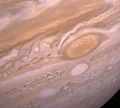
Jupiter and the Great Red Spot

Io in rotation
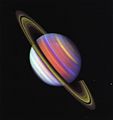
Saturn and its rings
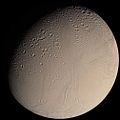
Enceladus
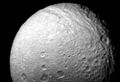
Tethys
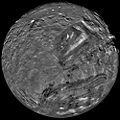
Miranda, showing its multiple terrains
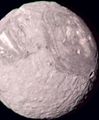
Miranda in color
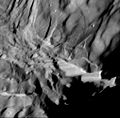
Miranda fault in high resolution

Ariel
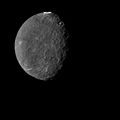
Umbriel

Titania in color
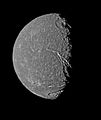
Titania in high resolution
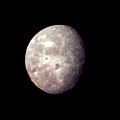
Oberon
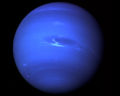
Neptune and Great Dark Spot
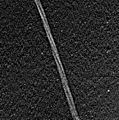
Neptune ring arc
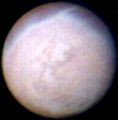
Triton in full face
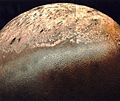
Triton at close range
Nereid
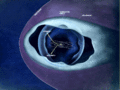
Voyagers 1 and 2 leave the solar system
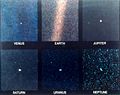
Distant images of six planets from interstellar space


 Browse |
References
- ↑ 1.0 1.1 Bell, Edwin V. "NASA Voyager Project Information." National Space Science Data Center, NASA, March 11, 2008. Accessed July 2, 2008.
- ↑ 2.0 2.1 2.2 2.3 2.4 Angrum, Andrea. "Voyager - Science - Planetary Voyage." JPL, NASA, March 23, 2004. Accessed July 2, 2008.
- ↑ 3.0 3.1 Leech, Jon. "Space FAQ 08/13 - Planetary Probe History." March 5, 2003. Accessed July 2, 2008.
- ↑ "Voyager 2 Proves the Solar System is Squashed." NASA Press Release 07-78, December 10, 2007. Accessed July 2, 2008.
- ↑ Angrum, Andrea. "Voyager - Mission - Fast Facts." JPL, NASA, February 21, 2008. Accessed July 2, 2008.
- ↑ Arnett, Bill. "Spacecraft." The
Nine8 Planets, January 18, 2005. Accessed July 2, 2008. - ↑ Humphreys, D. R. "The Creation of Planetary Magnetic Fields." Creation Research Society Quarterly 21(3), December 1984. Accessed April 29, 2008.
- ↑ 8.0 8.1 Humphreys, D. R. "Beyond Neptune: Voyager II Supports Creation." Institute for Creation Research. Accessed April 30, 2008


