Turtle
| Turtle |
|---|

|
| Scientific Classification |
| Families |
|
Suborder Cryptodira
Superfamily Testudinoidea
Superfamily Trionychoidea
Superfamily Kinosternoidea
Superfamily Chelonioidea
Suborder Pleurodira
Superfamily Pelomedusoidea
|
Turtles are reptiles that belong to the taxonomic order of Testudines. There are three types: tortoises that live on land, terrapins that live in freshwater and marine turtles that live in the sea.[1]
They are protected by two large shells which cover most of their body and into which most turtles are able to recoil for protection from predators or the elements. Turtles have a beak with no teeth. Like many reptiles they have a Jacobson's organ which is used to sense tiny chemical particles and food. Their eyesight is good both above and below the water.
Anatomy
Turtles use shells to protect them from their enemies. These shells are made of hard bone covered by scutes. The top shell is called the Carapace and the bottom one is called Plastron. A turtle is able to get its entire body inside its shells in order to protect itself.
Reproduction
Turtles reproduce sexually, and don’t mate for life. After they have mated the male will go away. The female will frequently dig a hole into which she will lay her eggs. In most cases the female will have nothing further to do with the offspring.
Ecology
Turtles affect their ecosystems in a number of ways. Many different types of turtles are used to carry seeds to different places which helps to keeps forests growing and prevents over population of plants. Also the Indian roofed turtles feed on different plants but it also eats dead animals and sometimes human waste. When turtles do this they are helping to minimise the spread of diseases.
Baraminology
Genes in the Mitochondria of Turtles have been analyzed by Ashley Robinson. In the process he tested the suggestion that Turles form four baramins which would separate marine turtles (chelonioids), soft shelled turtles (trionychoids), side necked turtles (pleurodires) and cryptodires which include land turtles. As part of the test he compared genetic data for the chicken, carp, African clawed frog, human and chimpanzee. He also compared several reptiles including the American alligator, whip tailed lizard, a gecko and a sea snake.[1]
It was easy to show the difference between chemical markers in turtles and non turtle vertebrates. It was more difficult to be certain whether the turtles were a single baramin (a holobaramin that includes all organisms of common descent) or a combination of several baramins. He did feel that he demonstrated that turtles at least form an apobaramin (a group of holobaramins) but couldn't be certain that his data clearly resolved how the turtles might be subdivided as created kinds.[1]
Difficulties for Evolution
Turtles present difficulties for the theory of evolution because they are so clearly different from reptiles as well as having such clear similarities between different types of turtles. Evolutionists would class the fossil turtle Proganochelys as the oldest known turtle at about 210 million years old. Although this turtle is different from present day turtles with a longer bony tail, creationists and evolutionists agree that it is truly a turtle. It has a full shell, giving it a rounded outline, seems to be made for swimming with slow movement on land, and is generally anatomically similar to modern day turtles. It was recently described a turtle with allegedly 220 million year old named Odontochelys.[2] According Chun Li et al. this turtle has teeth in both jaws, elongated snout, only ossified neural plates in the carapace and dorsal ribs extended among other features.[2] However this finding is subject to vigorous debates among vertebrate paleontologists. According to Robert R. Reiz and Jason J. Head although the scenario described by Chun Li et. al. for them are considered plausible, there are alternative interpretations that bring evolutionary consequences. These interpret that a carapace was present and that the apparent reduction of the carapace of the Odontochelys resulted from lack of ossification of dermal components, but the carapace was present. This led both to the conclusion that actually the morphology of their shells is actually a specialized adaptation. They conclude that the absence of most of the dermal carapace is a secondary loss associated with its aquatic habits rather than a primitive condition as inferred by Li and his colleagues.[3]
Evolutionists believe that lizards developed plates on their skin which through generations grew over more and more of the body until they fused into a turtle carapace. Martin cites the researcher Michael Lee's suggestion as an example of the evolutionary progression. Lee listed Captorhinus, Bradysaurus, Scutosaurus, and Anthodon as a possible progression from unplated lizard to plated lizard that is nearly a turtle. Martin questions the progression because of the great differences between lizards, plated or not, and turtles. He notes that it requires movement of bone structures past each other to make the change from lizard to turtle and wonders how this can happen in step by step evolution. Lizards generally rely on speed where turtles rely on armor, and that makes it difficult to imagine how an in between animal would be selected as better than a lizard. No skeletons show an in between, lizard/turtle mix, which makes it a continuing problem for evolutionists to demonstrate a clear pathway.
Most evolutionary scientists believe that green sea turtle migration pattern have evolved over millions of year.[4] However, mitochondrial DNA shows that these patterns could evolve in a couple thousand years (Bowen, Meyland,and Avise, 1989). The separation of turtle migration patterns could have "occurred a few 10s of 1000s of years ago at most".[5] This supports the idea that post-Flood ecologies could get back on their feet.
Gallery
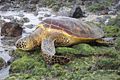
Green Sea Turtle
(Chelonia mydas)
Family: Cheloniidae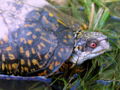
Gulf Coast Box Turtle
(Terrapene carolina major)
Family: Emydidae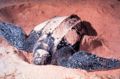
Leatherback Sea Turtle
(Dermochelys coriacea )
Family: Dermochelyidae


References
- ↑ 1.0 1.1 A Mitochondrial DNA Analysis of the Testudine Apobaramin by D. Ashley Robinson. CRSQ 33(4):262-272. March 1997.
- ↑ 2.0 2.1 Li, Chun; Wu, Xiao-Chun; Rieppel, Olivier; Wang, Li-Ting; Zhao, Li-Jun (November 27, 2008). "An Ancestral Turtle from the Late Triassic of Southwestern China". Nature (Nature Publishing Group/Macmillan Publishers Limited) 456 (7221): 497-501. ISSN 0028-0836.
- ↑ Reisz, Robert R.; Head, Jason J (November 27, 2008). "Turtle Origins out to Sea". Nature (Nature Publishing Group/Macmillan Publishers Limited) 456 (7221): 450-451. ISSN 0028-0836.
- ↑ Carr, A. and R J. Coleman. 1974. Seafloor spreading theory and the odyssey of the green turtle. Nature 249:128-130.
- ↑ Lewin, Roger. 1989. New look at turtle migration mystery. Science 243:1009.
Related References
- Turtle Wikipedia
- Sea Turtle Sea World
- Turtle The Leatherback Turtle
- Anatomy of turtles Anatomy of Turtles
- The Phantom Bridge Exposed: The Latest Turtle Attack by Randall Martin. CRSQ 33(1):15-17. June 1996.
External links
- Evidence for turtle evolution? by Jerry Bergman and Wayne Frair. Journal of Creation. 21(3) 2007.


