Moth
| Moth |
|---|

|
| Scientific Classification |
|
| Selected Moths |
| Achemon sphinx's larval stage |
 |
Moths are in the order Lepidoptera (meaning scale-wing), and this order also includes skippers, and butterflies. About 165,000 of moth species are described in the world. Their sizes vary, from 2-3 mm (smallest micromoths) to more than 150 mm (largest moths). Some tropical species have more than 250 mm wingspans. They have four membranous wings; back-wings are smaller than the front-wings, and they are entirely covered with scales. Moths have a long flexible siphoning tube as its mouth for drawing nectar from the food; flowers, fruits, etc. Usually moths have feathery antennae on their head designed for night-uses. They rest with their wings wide-open to form a tent around their body for protection. They have the body either colored or patterned with spots, bands, or stripes. The surface of the body is covered with lots of hairs, spines, knobs, and other features. There are two ways of pupating; when they pupate above the ground, they create protective cocoon, some silk, around their body. For this protection, moths usually combine natural materials such as leaves or their own body hairs to the silk. Many other species dig into the ground to pupate. [1][2]
Anatomy

Just like the other members in class insecta, the moth is divided into three parts; head, thorax, and abdomen. At its head, there is a pair of antennae which have sensors that allow moth to measure humidity and flight speed. Antennae, palps, legs, and many other body parts are used to smell. Behind the antennae, the compound eyes are placed. This kind of eye contains the surface lens for every facet. Beneath the lens, retinal cells are located, which forward nerve signals to optic nerve. It allows the moths to notice small movements, but hard to distinguish the distinct details.[3]They are large and give wide visual images to moth. Also, it has a long flexible siphoning tube shape of mouth on head. Its mouth consists of labrum, maxilla, and labial palp which help to draw the nectar from flowers. In the middle part of its body is the thorax. There are digestive tract, muscles and heart. However, the moth’s abdomen is made of 10 segments. Digestive, respiratory, excretory, reproductive organs are placed in the abdomen and small openings for respiration are also on it. The most unique features in the class insecta are wings. Especially for moth, it has beautifully colored scales on the both up and bottom part, and they cover the wings. Beneath its wings, it also has 3 pairs of legs for locomotion.
Digestive system
Moth has three parts for digestive system. There are foregut, midgut, and hindgut. The food is sucked by its siphoning mouth and gets moistened by the saliva from the salivary glands. Then the food passes through a esophagus, and stored a moment in the crop. After a short storage, it goes down to the gizzard to be digested. When gizzard opens the valve to get into the midgut, the food continues to go down to stomach. Gastric ceca surrounds the stomach and excretes digestive juices to help digestion. While hindgut absorbs water and salts, and then passes wastes out, major digestion and absorption of nutrients happens in midgut.
Respiratory system
They breathe through the thoracic and abdominal spiracles. Spiracles are attached to the tube called trachea. [4] This is the opening in the body wall and helps to respire by supporting the gases(also oxygen) throughout the body. There are some discoveries that the insects' body is relatively small, because of its' small lungs.
[5]
Circulation system
Moths have a simple, open circulatory system. This system involves carrying only the food not the oxygen throughout the body. And from looking at the insect's system of not carrying the oxygen through the dorsal vessel, we can know why its blood color is green, not red like the mammal blood. In all the parts of the body, dorsal vessels are located to circulate all the metabolites from fat body to cells. Hemocoel , the empty spaces of body, is filled of hemolymph which the heart ensures its mixing all the time. [6] With the heart's work through keeping the hemolymph safe, the circulation system forms. [7]
Excretory system
Malpighian tubules help to excrete the wastes from the body. This tubules take the circulated metabolites then wastes from the hemolymph to pour them into the intestine for excreting the wastes. When wastes and excretions from the midgut and Malpighian tubules are passed down to hindgut, wastes are excreted through its anus. [8] [9]
Wings of moth
Moth's wings are very unique. The name Lepidoptera means scale wings in Greek. It looks so beautiful because wings with the thin layers of chitin is covered by thousands of tiny scales that make the variety of colors. These wings do not just look good, but it must be strong and flexible to support the body.[10] Colors of the wings are made not just for their great appearances, but also the following purposes;
- camouflage helping the moth to hide ex) shaped and colored wings like leaf.
- warning coloration-bright colors are bad tasting
- finding a mate
- optical illusion-make their predators to think they look bigger than they actually are; scaring the predators
- soaking the heat-dark colors gain heat faster and better than bright colors. Moths are cold-blooded and this helps to warm down when they get too cold
Reproduction
Moths go undergo complete metamorphosis. Mostly, these species get together only to mate. Males locate the mates either by settling their districts or to fly around to look for the females. Some male antennae are sensitive so that they can locate mates from few miles. Once a male finds the suitable female, they follow wherever it goes until it stops on the ground. They releases pheromones to get attention from female. When they mate, male moves his antennae, flap his wings, then produces the sperm in a seminal receptacle where female stores the sperm. Courtship is generally very short and brief. Female lays the eggs through the ovipositor (in the last segment of a female's abdomen), which can hatch the fertilized eggs.
Their life cycle includes four different stages; egg, larva (caterpillar), pupa, and adult. The eggs hatch only in spring and summer. The larvae molts about 5-6 times to become a pupa. A pupa transforms into an adult after it rains, because it is easier to mate and lay eggs. It can take anytime from 15 days to 2 years from an egg of moth to become an adult, depending on its environment.[11]
Ecology

Female moths lay the eggs on some safe places and the eggs will overwinter be hatched in the following spring. The eggs are really tolerant at cold temperature since it can handle temperature as low as -35°C to -37°C. From larvae stage, it takes about 2-8 weeks to migrate to the ground and pupate.[12]
After they hatch from the egg, they spin themselves with a loose silken cocoon, to transfer into pupae stage. This usually occurs in the spring to early summer, before becoming as adult moths. There are many other kinds of moth, but their generation emerges in similar periodic time. For example, southern area moths emergence begins in early November to December through most of January, the second generation occurs from February to May. For the northern area moths' first generation emerges and done by December, its second occurs over January and early March, and sometimes, the partial third generation occurs in March to June. Males usually emerge a little faster than femlaes.[13]
Females mate only once for laying the eggs, and 2-3days after it has mated, they start to lay eggs. Females live only 6 weeks, but it takes up to 3 weeks to lay a series of eggs on the upper surface of leaves. The number of how many eggs can a female moth lay is diverse. Some females may lay from tens to even hundreds, and their range numbers are normally few hundreds. But from Australia, one kind can lay over 1000 eggs.[14]
Their food must be liquid, because it has the tube-like tongue called proboscis. A lot of them feed on nectar from various flowers, and they eat a variety of moist rotting food such as fruit, sap, animals, and animal droppings. Some will also find some nutrients from mud puddle.[15]
Their life forms in forest, mountain, desert, jungles, grasslands, marshes. So almost everywhere you go, you can see the Lepidoptera. As all of the living creatures have predators, moths have their own predators too. Birds, bats, and spiders are the main predators of moths, and moths avoid their predators' threat with their characteristics; wing colors for example.[16]
Relationship with lights

Nocturnal insects, including moths, come to the light because they are really sensitive. They even can see the objects in low level of light at least to avoid large objects, not sharply. They are studied and found to have an extremely low threshold. All organisms must see or sense within their environment in relation to other objects; food plants, mates, finding shelter, etc.
Some noctuid moths use the moon light for their migration. They migrate using the moon as a primary reference point. They measure their location with an internal geomagnetic compass. They check their flight path by 16 degrees to correct the direction every hour. On moonless nights, they navigate alone by the geomagnetic compass. Like the help of moon, moths need lights when circumference is dark.[17]
Gallery
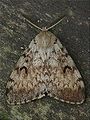
Gypsy Moth
(Lymantria dispar)
Family:Lymantriidae Genus: Lymantria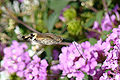
Hummingbird hawk-moth
(Macroglossum stellatarum
Family:Sphingidae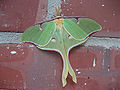
Luna Moth
(Actias luna)
Family: Saturniidae Genus: Actias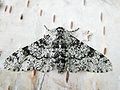
Peppered Moth
(Biston betularia )
Family: Geometridae Genus: Biston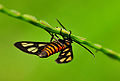
Scarlet Tiger Moth
(Callimorpha dominula)
family:Arctiidae


Moths
References
- Skippers Butterflies and Moths: Lepidoptera - Behavior And Reproduction Free Encyclopedias
- Insects- by Anne Frondorf
- The Lepidopterists' society by Ernest Williams, James Adams, John Snyder, and others, Mediasation, 1947.
- Bagworm moth compound eye by Dennis Kunkel Ph.D, Dennis Kunkel Microscopy,Inc.
- INSECT ORGANIZATION: STRUCTURE AND FUNCTION by Larry Keeley, Professor Emeritus of Entomology, Department of Entomology
- The Children's Butterfly Site by Opler, Paul A., Kelly Lotts, and Thomas Naberhaus, Big Sky Institute.
- Moth dynamics in subarctic birch forest by Andreas Viklund,Jane Uhd Jepsen, Nature Research (NINA), 2008.
- Insects and mites of pipfruit HortNET, 1999.
- BugGuide-Order Lepidoptera - Butterflies and Moths Iowa State University Entomology, 2009
- BugGuide-moths Iowa State University Entomology, 2009
External links
- European Butterflies and Moths by Christopher Jonko
- Butterflies and Moths of North America by NPWRC scientists
- Images of North American Moth Species by John Snyder, Department of Biology, Furman University, 2009.
- CLOTHES MOTHS by Mike Potter, University of Kentucky College of Agriculture, 2009.
- Gypsy Moth by M.McManus, N.Schneeberger, R.Reardon, and G.Mason, U.S. Department of Agriculture Forest Service, 1989.
- Luna Moth life cycle youtube.com


