Elephant
| Elephant |
|---|

|
| Scientific Classification |
|
| Genera |
|
Family: Elephantidae
Extinct Families:
|
 |
| African Elephant Herd |
Elephants are any of the species of mammals belonging to the taxonomic order Proboscidea. They are perhaps best known for being the largest land mammal on Earth. They exist in a wide range of sizes and shapes. The two extant species are the Asian elephant (Elephas maximus) and the African elephant (Loxodonta africana). The major differences between the two species is that the asian elephants have smaller ears and smoother skin then the African elephants. They also have slightly different body shape; the African elephant has a concave back and the Asian elephant has a convex back. The number of ribs, the number of nails ,and the rings and structure of the trunk are also different. The order Proboscidea also contains a number of extinct species including the mammoth (Mammuthus primigenius) and the mastodon (Mammut americanum). [3]
Body Design

Elephants have a unique body design that other animals lack. Elephants are large animals with body designs that is made to have a good chance of survival. The most important part of the Elephant is the trunk which we are most familiar with. At the end of an elephant's trunk there is a peculiar design which helps the animal to pick up items. In an Elephant there are more than 40,000 muscles in the trunk alone. From this they have the flexibility to have the motion that they need. The trunk is very strong to a point where they can completely pull a tree from the ground. [4] The trunk can be used as an exploratory organ, for feeding, for drinking, and even for friendly wrestling matches. At a hint of danger, elephants will lift it's trunk to smell the threat. The trunk is also the main part for tasks involving smelling and their primary sensory inputs along with hearing. It is impossible for an elephant to live if their trunk is damaged. [5] The tusk of an elephant is part of it's teeth. They will continue to grows even after the elephants are fully mature. The length of the tusks often show the age of the animal. But unfortunately, due to this fact tusks and the elephant have been slaughtered. Both sexes have tusks, but usually males have longer tusks. One side of the tusks is longer due to the use as a tool. They only use about two to three teeth at a time even though they have about 24 teeth. This is the main reason why their teeth don't wear out evenly. [4]
The ear serves a important function in the elephant. It regulates body temperature and helps to perceive a threat. Although it supports and help regulates body temperature in both of the species of elephants, African elephants have a better effect. Due to their larger ears and the wide surface area of outer ear tissue, hot blood in the arteries is cooled as it filtered through the capillaries and veins.[5] The skin of the elephant is not very thick except around the back and the sides. Their skin is very sensitive to the sun and most babies are covered by the mothers to avoid bad sun burns. To avoid and aid the issue, they tend to wallow in mud and cover themselves with dirt. [5] With their skin comes plenty of protection and their tiny hairs located all over the body. The legs of an elephant have plenty of traction, but they weren't designed to move fast. Elephants can't run like other four legged animals, but they can walk for hours at a steady pace.[4]The foot of an elephant is used to measure the overall size of a the animal,age, and the number of elephants in their group. Their spongy like shock absorber helps them to move silently and the sole of the foot is ridged and contains five toes which are buried inside the flesh of the foot.[6]The brain of an elephant weighs about 11 pounds. Their brain is larger than any other land mammals and they are born with 35% mass of the adult brain.[7]
Life Cycle
Elephants live together as a group called herds. In that the female elephant is called a cow, the baby elephant is called a calf, and the male is a bull.[8] The new born of an elephant has a mass of 77-113 kilograms and is about 91 cm tall. The young elephants, or the calf, is taken care by the mothers usually, but also by other females of the herd. When the baby elephant is born, the mother immediately helps the newborn rise to its feet because of survival issues. They must stand and drink their mom's milk.[9] After a time of the calf's the adolescent elephants tend to structure basic herd. During this time the male will begin to separate from the original herd and join the male herds. This shows the maturity level of elephants usually happening from age thirteen. Males also tend to form herds that travel further than the female herds. [7]
After the elephants child hood life-cycle, adult Elephants experience a similar life cycle as humans. [10] Elephants are considered an adult when they are about 18 years old and can live up to approximately 70 years. They start mating at the age of twenty and the cow, which is the female elephants ,usually have 2.5 to 4 years in between births.The period of gestation is about 22 months, the longest period out of all animal. When the baby is born, the mother chooses one specific babysitter who has the primary responsibility of an assist mother. Cows usually have one calf at a time and twins are known to be rare. As they get old , elephants suffer from diseases and aches that most humans have.[11] They are prone to cardiovascular disease which is a disease in the heart or the blood vessels. Another common health complication includes arthritis, which causes their joints to swell and ache. [10]
Ecology

African Elephant
African elephants are the largest land mammals. Their trunk is an extension to the upper lip and nose and use for communication and handling objects. Their diet feed is mainly on leaves and branches from bushes and trees. They also eat fruit, grass,and bark. They vary on the time of the year and on rainy season they like to eat more on grass then the dry seasons. [12] African elephant are rapacious eaters, thus determining their range. They are always searching for food and an adult male can eat about 300lb of food every day. In Savannas they gather in big herds roaming around in the lands searching for food or places to cool their body temperature. They are found in the African continent except for the desert region of Sahara desert.[13]
Asian Elephant
Asian elephants are the largest terrestrial mammal in Asia. They are smaller than African elephants and only have a single finger on their lip of the trunk. Asian elephants can eat around 661 lb per day, most of their time is spent in finding food. They mainly feed on grass, tree bark, twigs, leaves, roots, and small stems. They also sometimes consume bananas, rice and sugarcane due to the potential conflicts with humans. [14] Asian elephants live in variety of tropical forest habitats from moist, evergreen lowland forest to dry semi-deciduous teak forest. Their variety of diets allow them to lives in disturbed forests as long as it is enabled to move around. [15]
Mammoth and Mastodons
Mammoth
Mammoths were first described by German scientist Johann Friedrich Blumenbach in 1799. Mammoth lived in northern Africa. They were about 10 feet tall at the shoulder with long tusks and long reddish or yellowish hair. Many people think that Mammoth disappeared from disease, hunting and change in climate but it still exist as a mystery. Most mammoths were larger than elephants and if they had followed the elephants eating habits they would have been very significant beasts. Their diets consisted primarily of grasses, sedges and rushes.[16]
Mastodons
Mastodons were ancient giant elephants. They were smaller than mammoth. They were restricted to the North America continent and died out. They resembled a woolly mammoth and their tusks could grow up to five meters in length. Their teeth had blunt cones which were very different from other elephant families. Their skulls were larger and flatter than other mammoths. They were a big part of the Proboscidea order and still exist as a great history in the animal kingdom.[17]
Gallery
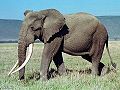
African Elephant
(Loxodonta africana)
Genus: Loxodonta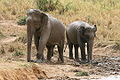
Asian Elephant
(Elephas maximus)
Genus: Elephas


Video
References
- ↑ Proboscidea.species.wikimedia. Web.modified on 20,January 2012.Author unknown
- ↑ Elephantidae.species.wikimedia. Web.modified on 9,January 2012.Author unknown
- ↑ Introduction to the Elephant Species of the World Ecotravel. Web. Accessed January 29, 2012 Author unknown.
- ↑ 4.0 4.1 4.2 Elephant Anatomy . Elephant-world. Web. Accessed January 16, 2012 Author unknown.
- ↑ 5.0 5.1 5.2 The Trunk. elephant.elehost. Web. Accessed January 16, 2012 Author unknown.
- ↑ The feet . Elephant-world. Web. Accessed January 16, 2012 Author unknown.
- ↑ 7.0 7.1 The brain . Elephant-world. Web. Accessed January 16, 2012 Author unknown. Cite error: Invalid
<ref>tag; name "brain" defined multiple times with different content - ↑ Elephants. kidcyber. Web. Accessed January 17, 2012 Author unknown.
- ↑ Baby . elephant elehost. Web. Accessed January 17, 2012 Author unknown.
- ↑ 10.0 10.1 Adult.Elephant.elehost. Web. Accessed January 28, 2012 Author unknown.
- ↑ Elephants. Andrews-elephants. Web. Accessed January 27, 2012 Author unknown.
- ↑ African elephant. World Wildlife. Web. Accessed January 28, 2012 Author unknown.
- ↑ African Elephant. buzzle. Web. Accessed January 28, 2012 Author unknown.
- ↑ asian elephant. World Wildlife. Web. Accessed January 28, 2012 Author unknown.
- ↑ Asian Elephants. nationalzoo. Web. Accessed January 28, 2012 Author unknown.
- ↑ About Mammoths. ucmp. Web. Accessed January 29, 2012 Author unknown.
- ↑ Hirst, Kris.Mammoth and Mastodon. about. Web. Accessed January 29, 2012 .


