Blue crab
| Blue crab |
|---|

|
| Scientific Classification |
|
| Binomial Name |
|
Callinectes sapidus |
The Blue Crab is a species of crab located in the Atlantic Ocean from Argentina to Nova Scotia. The exoskeleton of the Blue Crab is very hard like most crustaceans. They have claws for hunting and defensive purposes, as well as walking and swimming legs for escaping from predators. The Female Blue Crab only mates once in its entire life, unlike its male counterpart. After releasing urine full of pheromones she will find a male partner to collect a sperm packet. Then she continues to forage until she reaches a place where she can burrow into mud and allow the eggs to fertilize and move to a sponge structure on her underside.[1]. Then she will carry them on her underbelly in the sponge until they emerge as larvae that float off into the ocean to feed. The Blue crabs are used to make large profits in their harvest by commercial fisherman. They also have many different names like Jimmy, Sally, Sook, and Sponge Crab which distinguish male and female crabs and their maturity.
Anatomy

The outside of the crab is called the exoskeleton which is very hard. If the crab is looking for food or trying to escape from a predator they can use their swimming legs which are two paddle like legs that are located on the back. The blue crab, like most crustaceans, has a defense system consisting of their claws that are also used for catching their prey. This crab sees through eyes located on stalks that protect the eye, but they also use antennae that detect vibrations and chemical changes in the water. The blue crab must shed its shell, called molting, in order to have room to grow. Although the outside of the crab is very hard, the inside of the crab is very soft. The crab has gills that take oxygen into the bloodstream circulated by the heart and also has a stomach to digest food. All the cracks and curves of the crab are filled with muscles that move their claws, swimming legs and walking legs. To find if a blue crab is male or female you examine its underbelly. The male blue crab has a long broom handle shape on the underbelly, while the female blue crab has a ball with a small point where the sponge develops.[2]
Reproduction
Unlike the male blue crab, the female blue crab only mates once in its life. To become sexually mature, the females go through a pubertal molt and in that process they release urine into the sea that has pheromones in it to attract the male blue crabs. The male crabs will perform cradle carrying which involves protecting the females by carrying them until the molt is over. At that point the female's shell is soft and the male and female will then mate. The female will take and store sperm from the male crab and fertilize her eggs later. When all the mating is over the female crab goes to feed and gain energy before finding a place where she can fertilize her eggs. The female blue crabs prefer spawning places on the shore and she will lay in mud until the eggs develop in their sponge. The female will usually fertilize her eggs two to nine months after mating and places them in a large sponge like object on her underbelly until the babies emerge. The sponge usually takes two hours to develop and often contains two million eggs which need two weeks to develop.[3]
Ecology

Blue crabs are large predators in the bays of North America. The blue crab's life cycle includes very large migratory patterns which are very complex since they pass through various life stages in many different habitats. The blue crab is also very important to many commercial fishermen. The blue crab is found on the western edge of the Atlantic Ocean from Argentina to Nova Scotia, yet have been found in the waters of Japan and Europe.
The blue crabs have a large variety of predators including eels, drum, spot, trout, some types of sharks, and cownose stingray. The blue crab is an omnivore, which means it eats both plants and animals. Blue crabs eat thin shelled annelids, bivalves, small fish, some plants and basically anything else they can find to eat, including carrion. The Chesapeake Bay, in Maryland and Virginia, is known for their blue crabs because so much economic growth comes from harvesting the blue crabs. Fishermen received over one hundred million dollars from collecting blue crabs in 1993. Since then the harvests for blue crabs have not been as good. For example, in 2000, the money from blue crabs was only 45 million dollars. [4]
Blue Crab Names
There are many different names for the blue crab depending on their sex and their different stages of life. One of the names for a blue crab is the Jimmy, which refers to a male crab because of its T shape on its underbelly. Males have blue on the tips of their claws. Unlike the female, the male Blue crab is much more difficult to determine whether they are immature or mature. The only difference with the immature male is that the underbelly is slightly thinner and curved inward than the mature version. Another name for Blue Crab is Sally, which is used to describe an immature female crab. They are only referred to as a Sally by watermen for a shorter way to say "she crab". Also the immature female has a tighter underbelly unable to open because it can not yet have fertilized eggs. An adult female Blue Crab is given the name Sook. The Sook has an upside down U on its underbelly and is more open because it is able to carry eggs. The name Sponge crab is used for a female Blue Crab when it has its fertilized eggs stored in its sponge like structure.[5]
Gallery

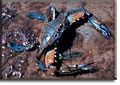
Blue Crab
(C. sapidus )

Blue Crab
(C. sapidus )


References
- http://www.serc.si.edu/education/resources/bluecrab/anatomy.jsp
- http://www.bluecrab.info/lifecycle.html
- http://en.wikipedia.org/wiki/Blue_crab
- http://www.bluecrab.info/identification.html


