Scarab beetle
| Scarab beetle |
|---|

|
| Scientific Classification |
|
| Subfamilies |
|
| Scarabaeinae |
 |
Scarab beetles are any of the species of beetles that belong to the taxonomic family Scarabaeidae. It is perhaps best known as a sacred animal in many cultures. One of the most commonly known scarab worshipers are the Egyptians. There are many legends surrounding the scarab beetle, and has been displayed in many works of art, from preserved ancient tombs to a few museums for any one to see.
Scarabs like the dung beetle feed on dung. While the diet of this invertebrate is quite repulsive, it is very resourceful to the environment. The scarab beetle rolls the ball of animal feces into a ball that can be up to fifty times its own body weight.
Anatomy
The general anatomy of all beetles in the scarab family starts with a body in the shape of an oval. All scarabs also have layered antennae used as sense organs. These unique antennae are often mistaken for "horns" growing out of the beetles head. Many of the male scarab beetles use these "horns" to fight each other with. For the dung beetle members of the scarab family, the tips of their heads are bordered with serrated rims to cut and shape balls of dung into balls. The insects forelegs are broad and flat to shape the dung balls, while the hind legs are long and thin for holding a ball in place as the beetle rolls the balls away with powerful forelegs. These beetles also come in a variety of brilliant colors. [1]An example of a scarab beetle is the dung beetle. This beetle can be up to 1/2 an inch to 1 inch long, with the female being slightly larger than the male. The come in two metallic colors, copper and blue-green. The male beetle has a "horn" on the top of its head, and the female has a tubercle, a small projection on the surface of the scarab's body. [2]
Reproduction
The scarab beetle reproduces sexually, and there is usually little to no courtship. The process starts when a female scarab beetle joins a male scarab in creating a nest. Both beetles work together to build the many tunnels in a nest, although the female beetle does most of the construction. The male scarab beetle's job is to excavate and get provisions for the female. Once the female lays her eggs, which are at least one third the scarab beetle's body length, the larvae will hatch and feast upon the nutrients in the nest. There the pupae will transform into an adult scarab beetle. When the beetles emerges from the old nest of its parents, it goes off to a new dung patch to start the life cycle all over again. The young beetle leaves on its own, the parents don't leave the nest.[3]
Ecology

The scarab beetle lives in deserts, farmlands, forests, and grasslands. These beetles can be found pretty much anywhere, except Antarctica and in the ocean. These beetles do not like to live any-where with extremely freezing or very hot climates. [4] The predators of the scarab beetle are bats, birds, reptiles, and other insect-eating creatures. Some examples of these creatures include the blue jay, the Big Brown bat, and the American toad. The most harmful creatures to the scarab beetle are human beings. Humans release toxic pesticides into the ground that kill scarab beetles when tending their gardens or farming. [5] The scarab beetle has two primary food sources. The first group eat vegetation and the second group, which most people know as dung beetles, eat fresh animal feces. Actually, it is only the larvae that eat the solid dung. The adults use their mandibles to squeeze out juices from the feces, and drink it. The scarab beetles do not need any other food source, including water, because they obtain all their nutrients from the decaying vegetation, or the decaying plant matter in the feces.[6] There is only one type of carnivorous scarab beetle in the family. This beetle, called the Deltochilum valgum, lives in South America and feeds on millipedes.[7]
Sacred Egyptian Scarabs
The scarab beetle is considered sacred to ancient Egyptian mythology. The Egyptians believed that scarab beetles had a connection to the sun god, Ra. The way a scarab beetle would roll a ball of feces across the desert sand reminded the Egyptians of how the sun would "roll" across the sky each day. These beetles were also thought to have a connection to life. [8]. The Egyptians made amulets in the shape of scarab beetles for both the living and the dead. The "heart scarab" was a funeral amulet that was carved out of stone, and would be placed on the mummy's chest. This would help the soul when it faced judgement from Osiris. The "heart scarab" would hold the life of the guilty soul and determine if the soul would enter the "after life" or be sent to the underworld.[9]. The scarab was used for many things: jewelry, seals, and amulets. There have even been mummified scarab beetles found in ancient tombs. Now, you have probably seen these scarabs in the "Mummy" movies, but real scarabs do not eat human flesh. That was just the producer's way of scarring the audience, so try not to confuse reality with fiction. To the Egyptians, the scarab beetles were a symbol of resurrection and new life.[10]
Gallery
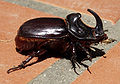
Rhinoceros beetle
(Oryctes nasicornis)
Subfamily: Dynastinae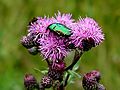
Rose chafer
(Cetonia urata)
Subfamily: Cetoniinae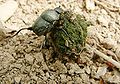
Dung beetle
(Scarabaeinaee )
Subfamily: Geotrupidae


References
- Scarab Beetle by Everything 2
- Anatomy2
- Reproduction
- Ecology1
- Ecology2
- Ecology3
- Ecology4
- Sacred Egyptian Scarabs1
- Sacred Egyptian Scarabs2
- Sacred Egyptian Scarabs3
- Sacred Egyptian Scarabs4


