Stick bug
| Stick bug |
|---|

|
| Scientific Classification |
|
| Families |
|
Superfamily: Timematoidea
Superfamily: Phyllioidea
Superfamily: Phasmatoidea
|
Stick bugs are any of the species of insects belonging to the taxonomic order Phasmatodea (sometimes called Phasmida). They are also commonly known as the walkingsticks, ghost insects, and leaf bugs. It is called these because of its slender, cylindrical, and cryptically colored body that was made to look like a twig or blend in with the leaves. They are terrestrial, nocturnal, phytophagous insects that can be found anywhere in the world.
The name Phasmatodea is Greek which means phantom. The largest of these insects is the Giant Stick Insect that was measured up to 33 centimeters in length (13 inches). Over 3,000 different types of Phasmatodea have been found, yet scientists still claim they are finding more every day. All Phasmatodea are herbivores. Most walking sticks are slow moving creatures that match their lifestyle. In very few tropical species the adults have well-developed wings. Most Phasmatodea are brachypterous (which means reduced wings),or they may also have no wings at all. These insects are most populated in tropical regions. They are solitary and are infrequently encountered because of their secretive nature. When they are disturbed they pretend to become dead and fall while blending into their backgrounds. They are known as weak clumsy fliers. [1]
Anatomy

The body type varies with in each species. For example some of them may have horns, spines and lobes on the abdomen or the legs, while others may have none of those features. Every species has a green or non-green form. What really determines their body shape and color is their environment. Phasmatodea have great camouflage and are often mistaken for leaves or twigs. When found or disturbed the Phasmatodea freezes up and falls down or sways in the breeze just like a leaf or twig. Members of the Timematidae family tend to resemble leaves. The abdomen is broad and flat, large lateral extensions for the legs, and 3 primary colors that consists of green, brown, and yellow. Many tropical stick bugs can grow to 30 centimeters in length.[2]
What separates phasmatodea from other phylum and shows they are in the monophyletic group is the following:
- All posses a pair of exocrine glands inside the prothorax. Some species have a gland that will discharge an irritating tear gas-like spray used for defense.
- The intestine has unique filament bearing glands
- The dorso-ventral muscles are arranged in parallel, short, and numerous around the abdomen.
- Males develop a unique sclerite termed the vomer. This body part is located among the genitalia. It allows the male to grasp the female when reproducing.
Reproduction

Males tend to be smaller and more gracile than the females. Reproduction usually occurs sexually. However many female Phasmatodea do not need to mate in order to create eggs. This is called parthenogenesis, but when such eggs hatch all the offspring produced will be female. Females do not have a strong ovipositor, therefore they do not insert their eggs into a host plant as other Orthoptera. As a result to this the eggs are dropped onto the ground, many times from great heights. Each egg is distinctively shaped, possessing both a operculum also known as a lid, and a micropylar plate. The eggs are large and often mistaken for plant seeds. The egg can be laid singly, dropped, flicked, buried, glued to a surface, or riveted to a leaf. Most of the eggs that are dropped on the ground are carried by ants which tends to disperse them. A full cycle from egg to adult can vary from a few months to a few years depending on the species.[3]
Gallery
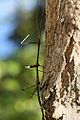
Northern walkingstick
(Diapheromera femorata)
Family: Heteropterygidae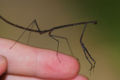
tiny walking stick
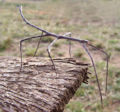
Ctenomorpha chronus
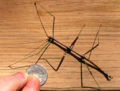
size of a normal phasmatodea
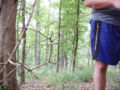
can you find it?
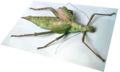
Malayan jungle nymph
(Heteropteryx dilatata)

Walking stick


References
- Phasmida Tree of Life Project
- Life History & Ecology by John R. Meyer. Department of Entomology
- phasmatodea
- Phasmatodea Wikipedia


