Barnacle
| Barnacle |
|---|

|
| Scientific Classification |
|
| Orders |
| Gooseneck Barnacle |
 |
Barnacles can be found on just about any beach in the world. These marine crustaceans are sessile filter feeders, which are most commonly known for being attached to rocks and hulls of ships. They are also known for cutting up skin when stepping on them. They are a major problem for sailors; when enough barnacles cluster on the ship they make the ship heavier and less aerodynamic. Also, because of an extremely strong adhesive, they are difficult to remove from just about any surface. Though they are known as a nuisance, they do have some good qualities as well. For one, they help to filter out the water by feeding on the detritus and plankton, which helps the water to stay clean and clear.[1]
Anatomy

There are several parts that make up a barnacle. The outermost layer of a barnacle is its shell; the shell of the adult barnacle is usually composed of four to eight [[calcareous] plates which can form different shapes depending on the species of barnacle.[2] The entrance to the barnacle is also covered by two calcareous plates which can pull back to open up or close this portal to the interior of the barnacle.[3] These plates will grow and expand by adding more material to itself.
[4] The plates that cover the opening to the barnacle are operated by several sets of muscles: the scutal depressor muscles, the scutal abductor muscle, and the tergal depressor muscle. These are used to open and close the the plates that cover the opening to the barnacle.[5]
Immediately inside the Barnacle are six legs that are used for three purposes. These legs or cirri are usually formed in a feather like shape and have tiny sensory hairs called setae which cover the cirri.[6] These legs are used for filter feeding, are the main source of response, and they are used for respiration in class cirripedia.[7] When used for feeding the legs are extended into the water by the barnacle in order to catch whatever food it can. The legs are then retracted and whatever particles the legs have caught are brought to the mouth..[8] They are also used as the sensory organs of the Barnacle. The tiny sensory hairs on the cirri detect danger and water level in order to tell the creature whether to open or close the two calcareous plates at the top [9]
The digestive system is composed of the mouth, esophagus, stomach, small intestine and anus. The digestion process goes something like this: After the Barnacle's cirri feed the food to the mouth it travels down a short esophagus. After flowing through the esophagus it ends up in the stomach, where it is stored for some time. It then goes down the small intestine where the nutrition is absorbed. After the nutrition is absorbed the waste is then excreted out the anus, which is then filtered back out into the ocean.[10]
Barnacles also have two antennules that secrete a cement-like glue that they use to attach themselves to rocks, boats, and many other surfaces. The glue is secreted by cement glands located inside of the barnacle.[11]
Reproduction

Barnacles are hermaphrodites that reproduce by cross-fertilization. This means that they have both male and female reproductive organs, but they fertilize with other barnacles and not with themselves.[12]
The life process of a barnacle consists of three stages. The nauplius, the cyprid, and the adult stage.[13] The first step of the process is fertilization. The barnacle will release sperm into the ocean. The sperm will travel until the sperm enters another barnacle. When the sperm reaches another barnacle it is delivered to the mantle cavity to fertilize the eggs that are stored there. In some species the barnacle will extend its extremely long penis to another barnacle and inject the sperm to fertilize it.[14]
The eggs will hatch as a nauplius: a small larval creatures with one eye, two antennae, and several mandibles.[15] The nauplius will usually moult six times before it morphs into the next stage. It usually moults once before it is released from the mantle cavity and into the open ocean.[16]
After it has spent its time as a free-swimming creature and has moulted enough it will change into its next form. The cypris stage of a barnacle is a bivalve with the creature between the two shells. The cypris has one naupliar eye, and two compound eyes that it uses to navigate around the ocean. It has an antennae from its previous form and six pairs of appendages that help it to move around the ocean.[17] It then uses its antennae to find an appropriate location to settle. This search can take days or weeks, and the cypris conserves energy by not feeding. When the cypris has found somewhere to settle it extends its antennae to the surface and secretes a cement-like substance. It then pulls itself to that surface and becomes permanently attached. After time it will eventually morph into its adult form.[18]
Ecology
Barnacles are marine animals that live in both shallow and tidal waters.[19]The Barnacles are also suspension feeders that are sessile and feed on detritus and plankton. They use their net-like cirri to reach out into the water and back in a constant drum-like rhythm in order to capture food.[20] They can be found anywhere in the intertidal zone on just about any coast in the world.[21] Also they can be found glued to just about any surface. These surfaces include ships, rocks, whales, plants, and docks.[22]
Their predators include sea stars, sea snails, some birds, fish (Such as Sheephead), and worms. Also dangerous chemicals can harm the Barnacles. This can be toxic to barnacles when oil spills occur.[23] Limpets and Mussels also invade and compete with the barnacles for space.[24]
There are two ways that barnacles use to overcome their predators. The first is a very fast and efficient reproductive system. This enables the barnacles to produce higher up and closer to shore, allowing them to get bigger and making them harder to reach from predators. The second is a defense called "swamping". In swamping the Barnacles produce a high number of offspring that all cling to one specific area. This ensures that there's a good chance that at least a few of them will survive. These are both effective strategies in defense against predators.[25]
Biomimicry
- Main Article: Biomimicry
Doctors and scientists are very interested in manufacturing the type of glue that a barnacle uses to attach itself to rocks and other surfaces. Research has shown that this is an extremely strong adhesive. A thin layer three ten-thousandths of an inch thick over an area of one inch can support a weight of seven thousand pounds. It can also withstand temperatures up to 380 degrees Fahrenheit without cracking, and it will only soften at temperatures above 6,000°F. It is also resistant to water, strong acids, solvents, and alkalies. This would be a valuable substance if we could find out how to produce it.[26]
There are a thousand ways that it could be used. This includes medical, construction, military, and even everyday uses. This could include mending bones, patching up skin, repairing tears in materials, holding stuff together, and hundreds of other uses. [27]
Gallery
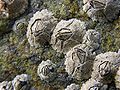
Acorn Barnacles
(Semibalanus Balanoides)
Thoracica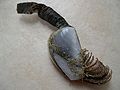
Goose Barnacle
(Lepas anatifera)
Thoracica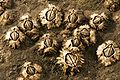
Australasian barnacles
(Elminius modestus )
Thoracica


 Browse |
References
- Barnacles by Keith Davey, Published by MESA, 2000.
- Biology of Barnacles by Museum Victoria Australia.
- How Barnacles Attach themselves to rocks by Museum Victoria
- Barnacles by Wikipedia.
- Barnacle Facts by Invertebrate Zoology Section, 2001
- Overview of Crustaceans by Water Encyclopedia, Published by Advameg Inc.
- Barnacle Anatomy by Richard Fox, Published by Invertebrate Anatomy OnLine, 2001
- Barnacle Response and Behaviour by John C.G. Sturgy, 1983
- Barnacle Reproduction by The Columbia Electronic Encyclopedia, Published by The Family Education Network
- Barnacles by AbsoluteAstronomy.com
- Barnacles by ThinkQuest, Published by Oracle Education Foundation
- Taxonomy by WorldLingo.


