Aluminum oxide
| Aluminum oxide | |
|---|---|

| |
| General | |
| Other names | alumina aluminium(III) oxide |
| Molecular formula | Al2O3 |
| Molar mass | Molar mass::101.96 g/mol |
| CAS number | CAS number::1344-28-1 |
| Properties | |
| Solubility in water | insoluble |
| Melting point | Melting point::2054 °C |
| Boiling point | Boiling point::3000 °C |
| Thermal Conductivity | 18 W m−1 K−1 |
| Structure | |
| Coordination geometry |
octahedral |
| Crystal structure | cubic |
| Thermodynamic data | |
| Standard enthalpy of formation ΔfH |
−1675.7 kJ mol−1 |
| Standard molar entropy S |
50.92 J mol−1 K−1 |
| Heat capacity Cp | 79.04 J mol−1 K−1 |
| Hazards | |
| MSDS | External MSDS |
| NFPA 704 |
0
2
0
|
| Flash point | non-flammable |
| Related compounds | |
| Other anions | aluminium hydroxide |
| Other cations |
boron trioxide |
| Except where noted otherwise, data are given for materials in their standard state (at 25 °C, 100 kPa) Disclaimer and references | |

Aluminum Oxide is a chemical compound consisting of two aluminum ions and three oxygen ions demonstrated by the formula Al2O3 Another commons name for aluminum oxide is aluminium oxide which is its proper name. It may also be referred to as aloxide, aloxite, or alundum. It is most frequently found in a crystalline polymorphic phase which s comprised of the mineral corundum which helps form several precious stones such as rubies and sapphires. Aluminum oxide is very commonly used in industry to produce aluminum metal because of its hardness, and high melting point.
Properties
Aluminum oxide is also a electrical insulator because of it's high thermal conductivity (about 30 Wm K-1) Aluminum oxide s also completely insoluble in water. It is also commonly used as an industrial abrasive material for cutting tools.
Aluminum oxide is responsible for the resistance of metallic aluminium to weathering. It also is very reactive with atmospheric oxygen because of its thin passivation layer. Aluminum oxide is often used to enhance metals and prevent rusting especially in bronze. The structure of aluminum oxide is amorphous, but several reactions such as plasma electrolytic oxidation will make it harder. This compound is an amphoteric substance meaning that it can react with both acids and bases acting as an acid with a base and a base with an acid neutralizing the other ion and producing a salt.
Occurrences

Oxide is mined up from the earth. Corundum is the most common occurring crystalline form of aluminum oxide. Corundum can also be found in higher quality forms that compose rubies and sapphires. The red in a ruby owes its color to traces of aluminum oxide. Likewise, sapphires occur in various colors depending on the varying amounts of impurities from other substances such as iron or titanium.
Uses
Aluminum Oxide can be used in the making of ceramics. It is very useful when you are making ceramics because it has good mechanical strength, heat conductivity, fire resistant, corrosion and wear resistance, sliding properties, and it is a good electric insulation. Those properties do not relate to all of the ceramics that are created from aluminum oxide. Aluminum oxide can be mined and sometimes it is used as a natural abrasive so most emery boards are made from aluminum oxide, also a lot of sandpaper is made from Aluminum Oxide. It is also used in the coating of compact fluorescent lamps. Microdermabrasion uses aluminum oxide crystals. Aluminum oxide can be found as a crystal which is called corundum.
Gallery
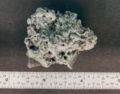
Aluminum oxide slag - a byproduct of Solid rocket motor.

Related References
- Aluminium OxideWikipedia
- Uses of Aluminum Oixde aluminum Occurrence, uses, and properties.
- CeramTec The Ceramic ExpertsWhat is Aluminum Oxide
- ALUMINIUM Aluminum
- Properties of aluminum oxideOptical Properties of Aluminum Oxide
- [1]optical properties
| ||||||||||||||


