Summary
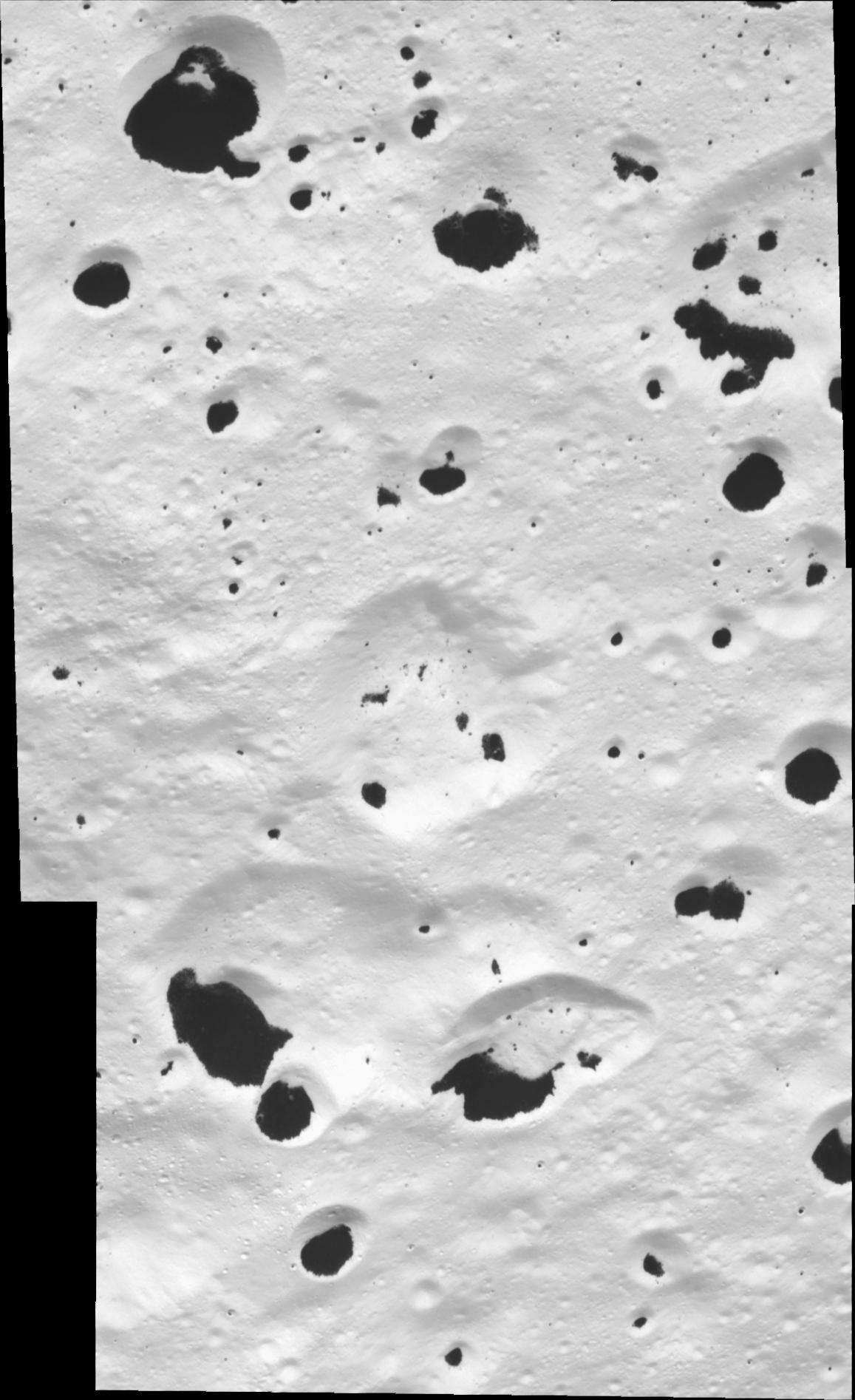
Iapetus with impact craters filled with dark material at the edge of Regio Cassini
Original caption
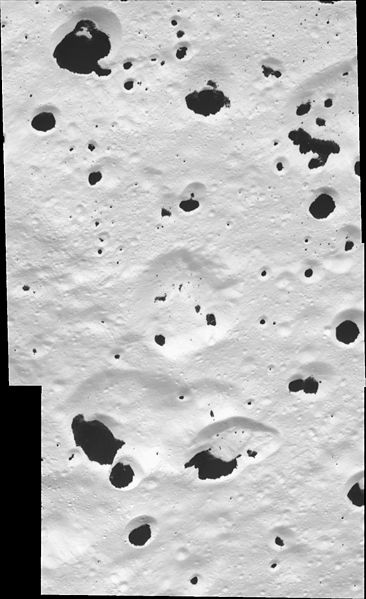
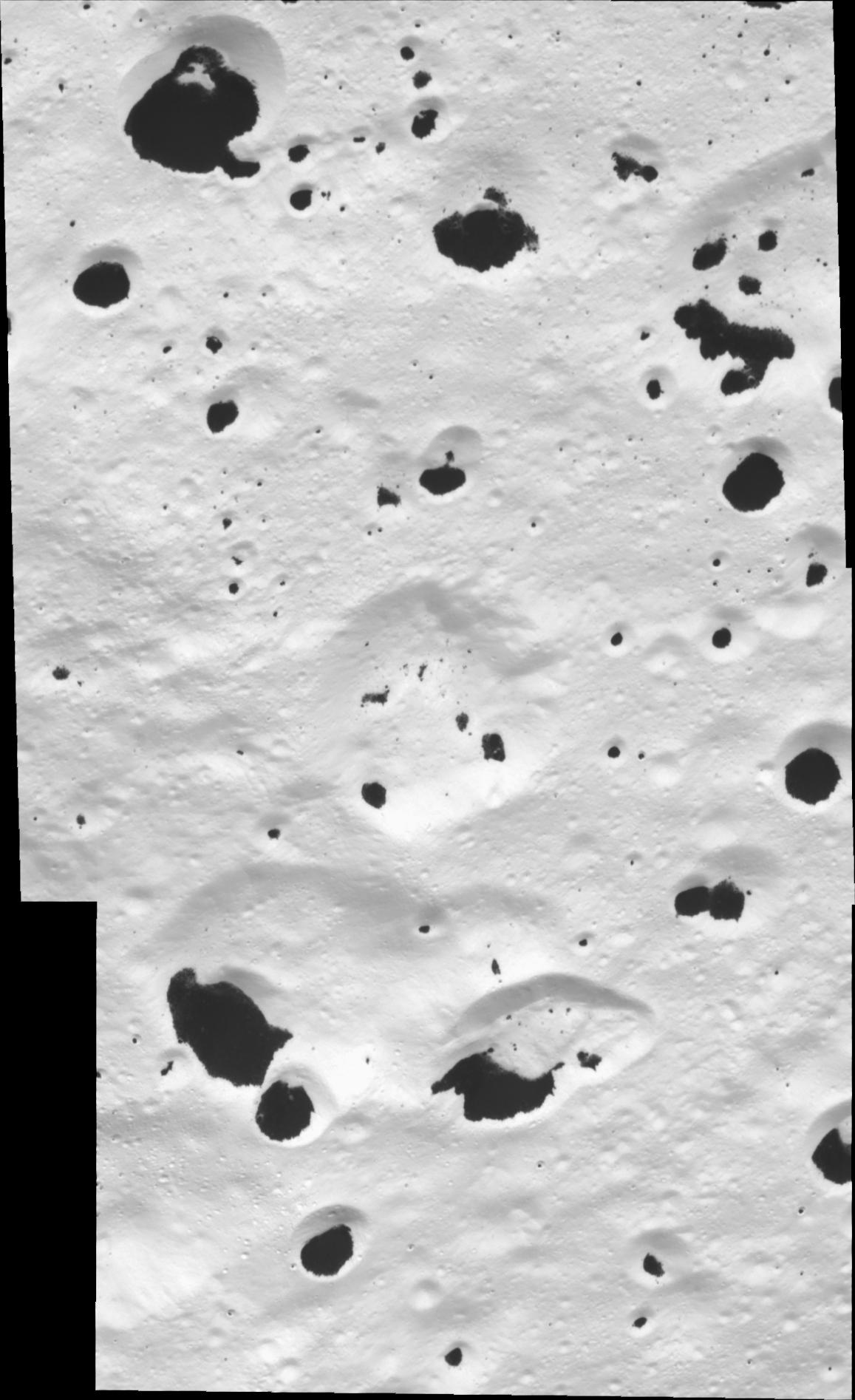
At high resolution, terrain in the transition region between bright and dark hemispheres on Saturn's moon Iapetus reveals a spotty appearance reminiscent of a Dalmatian. The bright material on the frozen surface of Iapetus, 1,468 kilometers (912 miles) across, is water ice, and the dark material is likely carbonaceous in composition.
The dark material is preferentially found at the bottoms of craters. Bright water ice forms the "bed rock" on Iapetus, while the dark, presumably loose material apparently lies on top of the ice.
The terrain seen here is also visible in PIA08383, but it is viewed here at higher resolution.
The mosaic consists of two image footprints across the surface of Iapetus. The view is centered on terrain near 42 degrees south latitude and 209.3 degrees west longitude, on the anti-Saturn facing hemisphere. Image scale is approximately 32 meters (105 feet) per pixel.
The clear spectral filter images in this mosaic were obtained with the Cassini spacecraft narrow-angle camera on Sept. 10, 2007, at distances ranging from 5,363 to 5,884 kilometers (3,332 to 3,656 miles) from Iapetus.
The Cassini-Huygens mission is a cooperative project of NASA, the European Space Agency and the Italian Space Agency. The Jet Propulsion Laboratory, a division of the California Institute of Technology in Pasadena, manages the mission for NASA's Science Mission Directorate, Washington, D.C. The Cassini orbiter and its two onboard cameras were designed, developed and assembled at JPL. The imaging operations center is based at the Space Science Institute in Boulder, Colo.
For more information about the Cassini-Huygens mission visit <http://saturn.jpl.nasa.gov/home/index.cfm>. The Cassini imaging team homepage is at <http://ciclops.org>.
Copyright status
This image is credited to NASA and the Jet Propulsion Laboratory. Per JPL/NASA policy and applicable United States federal law, such images are in the public domain, or, if they are owned by individuals or institutions other than NASA or JPL, may be used for any journalistic, educational, or personal purpose (but not a commercial purpose) without further authorization. NASA and JPL images, other than their respective institutional logos, or photographs of actual persons, are not subject to copyright and may be used without additional permission, unless otherwise declared. For details, see the JPL Image Use Policy Declaration.
Source
NASA/JPL/Space Science Institute <http://photojournal.jpl.nasa.gov/jpeg/PIA08382.jpg>